 Tim Ross
Proton Calendar is genuinely end-to-end encrypted, which makes it the closest thing to a peer in this series and the hardest comparison to write. Proton and SilentSuite agree on the goal and disagree about walled gardens, and the two draw the line between encrypted content and server-visible metadata in different places.
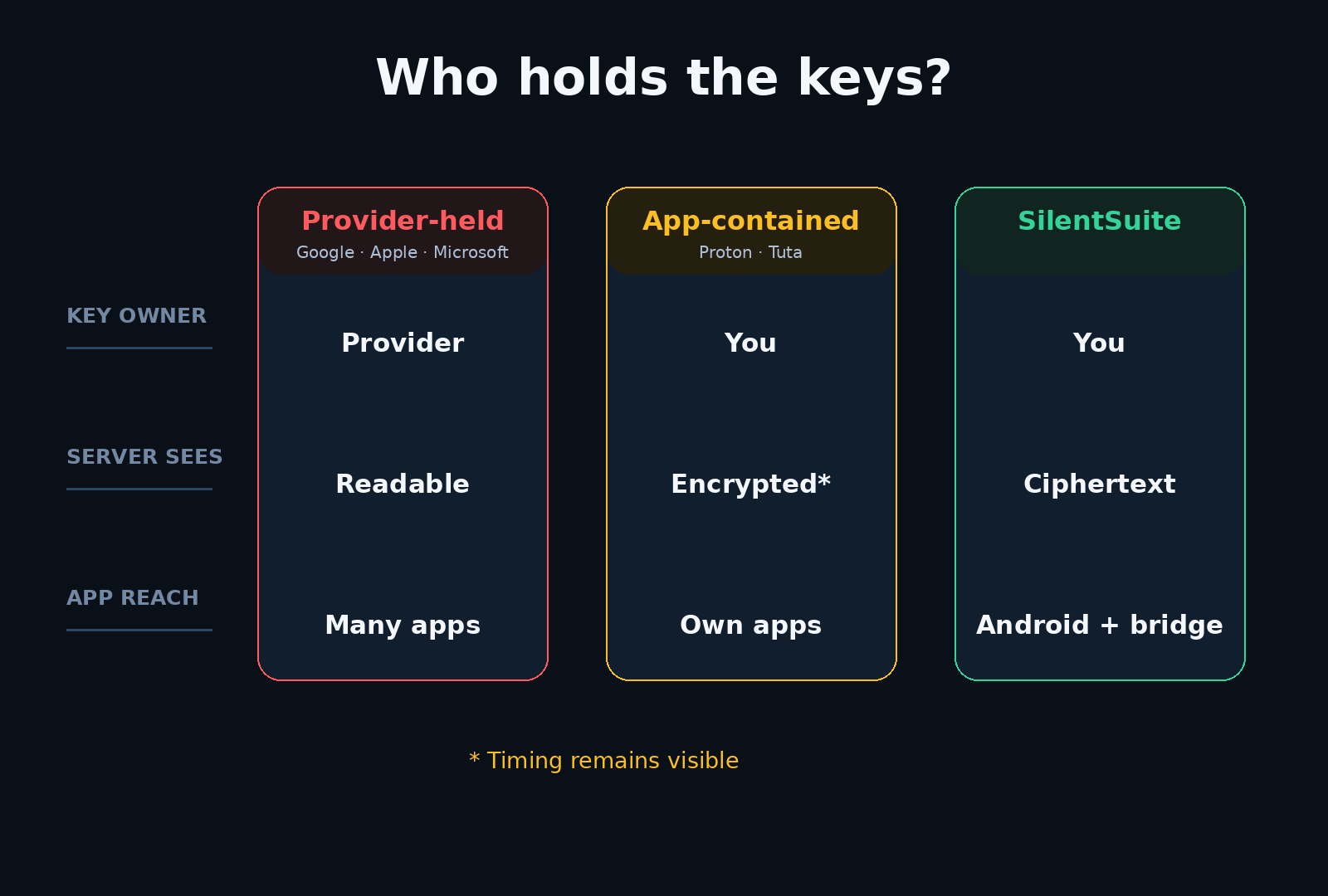
Proton encrypts event content: title, description, location, attendee list, calendar comments, and member alarms. Start and end times, recurrence rules, and alarm timing are signed rather than encrypted, so Proton's server can read when your events happen and how they repeat. Proton has no CalDAV, only read-only iCal subscriptions. SilentSuite encrypts the whole item, timing included, and serves CalDAV from a bridge on your own computer.
What does Proton Calendar encrypt?
A lot, and Proton documents it. According to Proton's Proton Calendar security model, the following are encrypted and signed on your device: event title, description, location, the attendee list (Proton states that “the email addresses of attendees cannot be accessed by Proton Mail”), per-calendar comments, and member-specific alarm settings.
That is a real end-to-end encrypted calendar, and it deserves to be described as one. Proton Calendar is not in the same category as Google, Microsoft, or Apple, whose servers hold event titles in readable form.
What can Proton's server still see in your calendar?
The same security model page lists what is signed rather than encrypted: event start and end times with their time zone, repetition rules and date/time exclusions, the unique event identifier, and alarm timing.
Signed means the server can verify the data has not been tampered with. It also means the server can read it. So Proton's server knows when every event in your calendar happens, how long it lasts, which events repeat, on what rule, and which dates you removed from a series. It does not know what any of them are called.
That is a meaningful amount of behaviour. A recurring Tuesday 18:00 entry every week for a year, with three exclusions, is a pattern even without a title. SilentSuite's design encrypts the whole item instead: through the Etebase protocol, event content and collection metadata are ciphertext, and the server sees item existence, counts, and revision timestamps rather than start times and recurrence rules. The field-level detail is in what SilentSuite actually encrypts.
One caveat on SilentSuite's side of the argument: Proton's security model post was last updated on 2022-11-02. It is the document Proton links as current, and this comparison is written from it, but it is worth rechecking rather than treating as permanent.
Does Proton Calendar support CalDAV?
No. Proton's own support page states it: “Proton Calendar doesn't support CalDAV, so you can't set up a direct two-way sync with an external calendar.” External calendars are subscribed through iCal links, read-only, refreshing every 4 to 16 hours depending on the provider. Subscribed calendars cannot be edited, deleted, set as default, shared, or exported.
There is a rumour in circulation that Proton added inbound CalDAV synchronisation in 2026. Proton's live documentation says otherwise, so I do not repeat it.
Your own Proton calendars can be exported: Settings, All settings, Proton Calendar, Import/export, Download ICS. So this is a walled garden with a door, not a lock-in trap.
Two answers to the same CalDAV problem
CalDAV assumes the server can parse, search, and merge the objects it stores. A server that cannot read an event cannot answer a CalDAV query about it. Every encrypted calendar has to resolve that conflict somehow.
Proton's answer is to not support CalDAV, and to keep calendaring inside Proton's own apps and web client. SilentSuite's answer is a bridge that runs on your computer: it holds your keys, decrypts locally, and serves CalDAV and CardDAV on 127.0.0.1 so Thunderbird, Evolution, or Apple Calendar on macOS can talk to it while the server keeps holding ciphertext. How the CalDAV bridge works covers the mechanics.
Both answers are legitimate and both cost something. App-contained storage keeps other apps on your device out. Standards support lets them in, on purpose, which is convenience bought with local exposure. I took both sides seriously in walled gardens vs system integration.
Proton Calendar vs SilentSuite
| Feature | Proton Calendar | SilentSuite |
|---|---|---|
| E2EE | Yes (times and recurrence signed, not encrypted) | Yes |
| CalDAV | No (ICS subscriptions, read-only) | Via bridge |
| Native integration | App-contained: Proton apps and web only | Native Android app + local bridge on desktop |
| Open source | Apps open source | Yes, AGPL-3.0 |
| Price | Free tier; Mail Plus from €3.99/mo (annual) | From €3/mo (annual) |
| Status | Active | Active |
Proton pricing from proton.me as of 2026-08-15: Free at €0 with 3 personal calendars; Mail Plus at €4.99/mo or €47.88/yr, which is €3.99/mo on annual billing. SilentSuite is €3/mo on the Early Adopter tier billed annually. Both are list prices, and Proton runs promotions.
What about contacts?
Worth knowing if you are weighing the whole suite rather than the calendar alone. Proton's contacts support page states that your contacts' display names and email addresses “are encrypted at rest but are not secured using zero-access encryption. This means that we can access this information.” Phone numbers, addresses, organisation, birthday, and notes are zero-access. Proton needs the readable fields for autocomplete, spam filtering, filters, search, and threading.
SilentSuite encrypts the whole vCard, because it does not run a mail service that needs to route anything. That is a design consequence, not a virtue: Proton is solving a harder interoperability problem than SilentSuite is. I looked at every provider's contact fields in encrypted contacts in 2026.
FAQ
Is Proton Calendar end-to-end encrypted?
Yes for event content. Proton's security model documents the title, description, location, attendee list, per-calendar comments, and member-specific alarm settings as encrypted and signed on your device. Timing data is a separate case.
What can Proton see in my calendar?
The signed fields: event start and end times with their time zone, repetition rules and date or time exclusions, the unique event identifier, and alarm timing. Signed means the server can verify the data, and it can also read it. It does not learn what any event is called.
Can I connect Proton Calendar to Thunderbird or Apple Calendar?
Not as a two-way sync. Proton states that Proton Calendar does not support CalDAV, so external calendars arrive through read-only iCal subscriptions that refresh every 4 to 16 hours. You can export your own calendars as ICS from settings.
Is Proton Contacts zero-access encrypted?
Partly. Phone numbers, addresses, organisation, birthday, and notes are zero-access. Display names and email addresses are encrypted at rest but not zero-access, and Proton states that it can access that information.
How is SilentSuite different from Proton Calendar?
In two places. SilentSuite encrypts the whole calendar item through Etebase, including start and end times and recurrence, so the server sees item existence, counts, and revision timestamps instead. And it keeps CalDAV, served by a local bridge on 127.0.0.1 rather than by the server.
If you already live in Proton's ecosystem and want mail, calendar, and VPN from one provider, Proton is a coherent choice and a serious one. If you want the whole calendar item encrypted, including its timing, and you want your own calendar apps to keep working, get started with SilentSuite. The wider field is in encrypted calendar sync in 2026.
Interested in private sync?
SilentSuite is available now as a public beta. Sign up and start syncing your calendar, contacts, and tasks with end-to-end encryption.
Get started for free