 Tim Ross
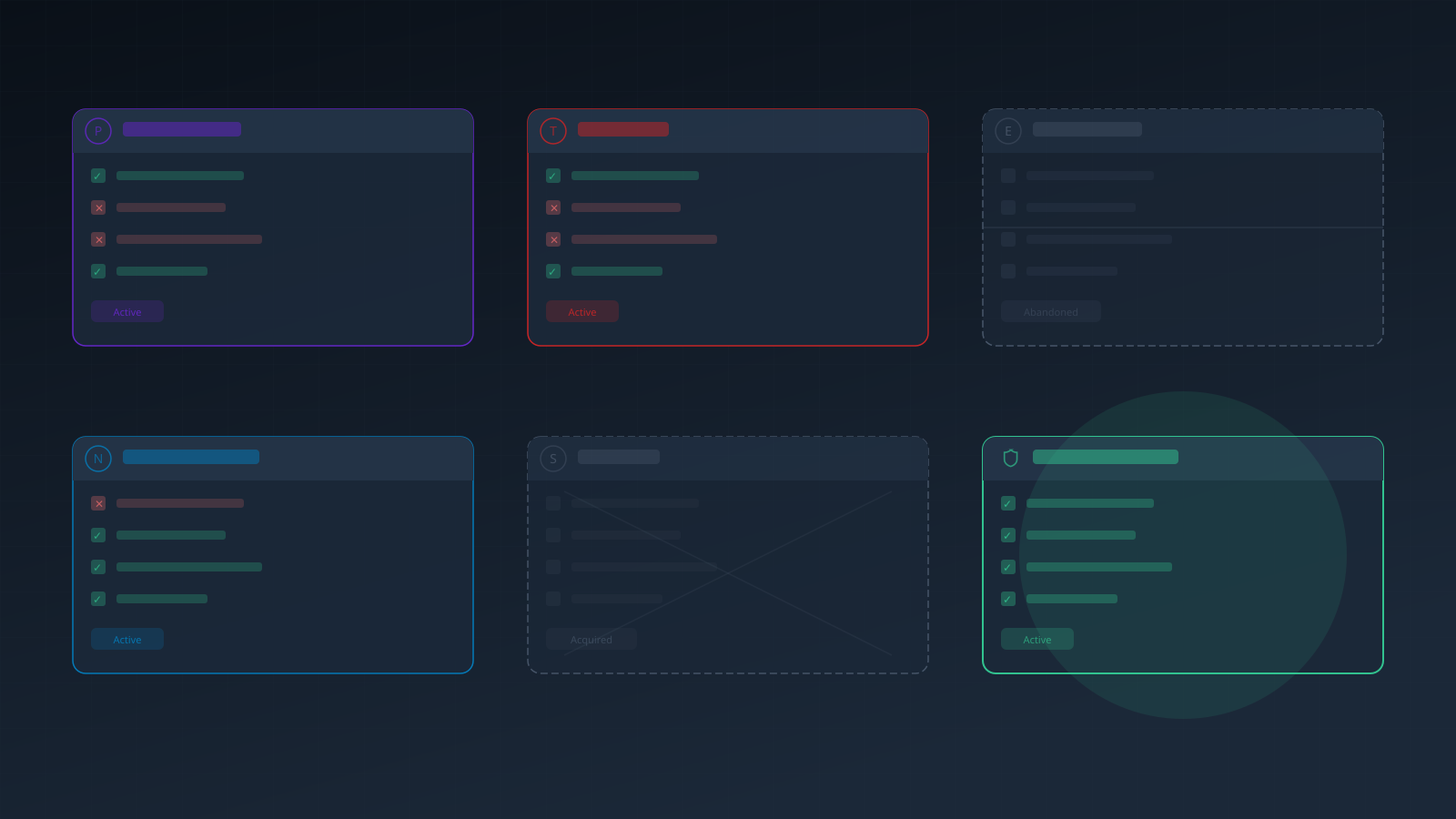
Every encrypted calendar on the market in 2026 answers the same three questions differently: what the server can read, whether standard calendar apps can reach your events, and whether anyone is still shipping releases. Proton Calendar, Tuta Calendar, EteSync, Nextcloud, and SilentSuite each land somewhere different on all three. This comparison is written by one of the five, so it also says where SilentSuite loses.
Here's the good news: in 2026, there are multiple services that offer some form of encrypted calendar sync. Five years ago, you could count them on one finger. The space has grown.
The bad news? Most of these options are incomplete, locked into a specific ecosystem, or maintained at a trickle. If you've spent any time trying to find a proper encrypted replacement for Google Calendar, you know the frustration. Things look promising on the surface, then you dig in and find deal-breaking limitations.
I wanted to write an honest comparison. Not a marketing piece where I trash the competition and declare myself the winner. Just a clear-eyed look at what exists, what works, and what doesn't.
Google Calendar is not in this comparison, because it is not an encrypted calendar at all. If that is the service you are leaving, I went through exactly what Google can see in SilentSuite vs Google Calendar, and the broader question of who can read your calendar covers Apple and Microsoft too.
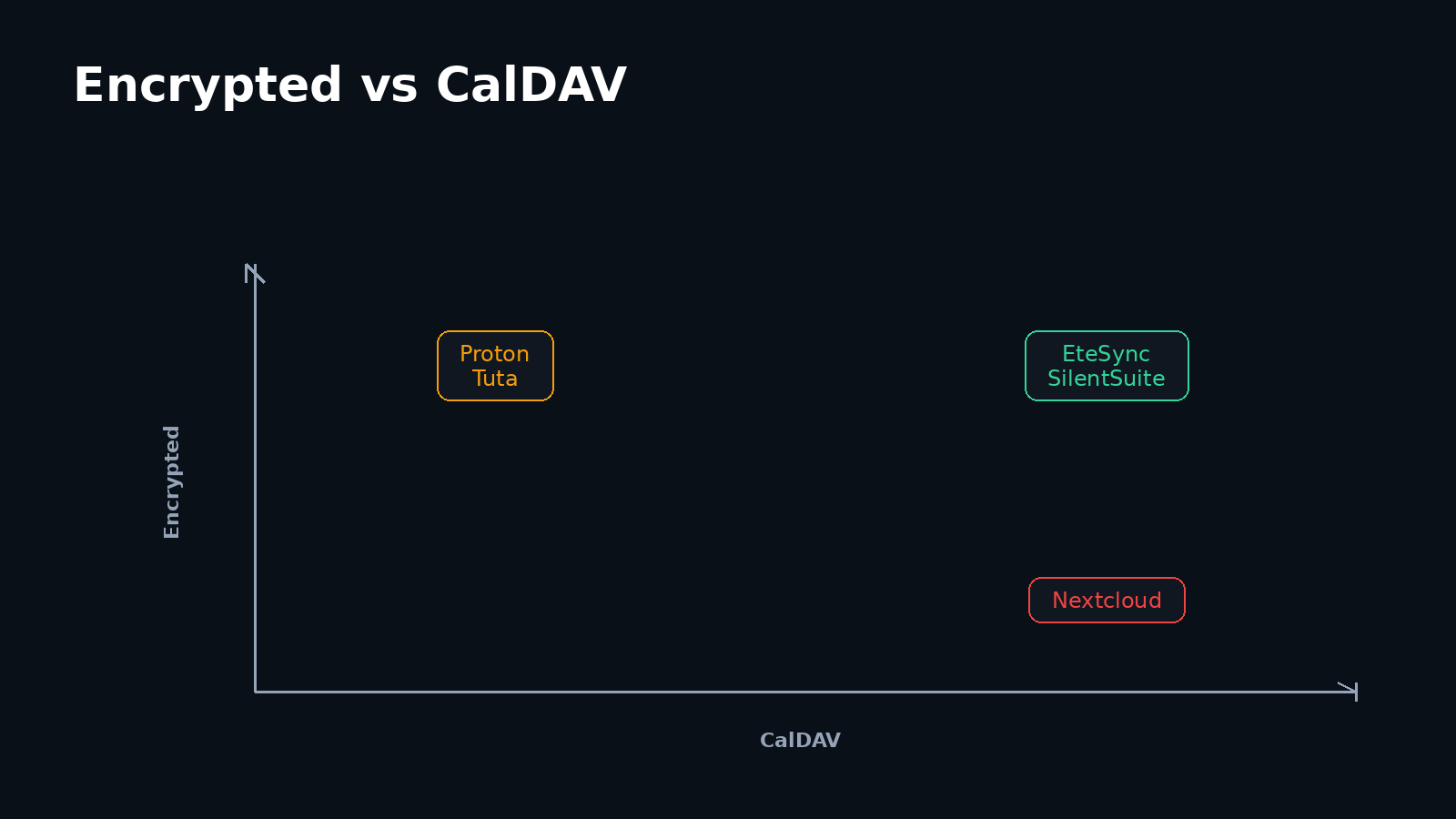
On the first question, Nextcloud is out: it speaks CalDAV but does not end-to-end encrypt calendars, so whoever runs the server can read every event. On the second, Proton and Tuta encrypt event content on your device but neither supports CalDAV, so third-party calendar apps cannot sync with them. EteSync and SilentSuite both encrypt calendars, contacts, and tasks on the Etebase protocol and expose CalDAV through a bridge that decrypts on your own machine. On the third, SilentSuite is the one still shipping, from €3/mo hosted or free to self-host under AGPL-3.0.

Proton Calendar
Proton Calendar is the most well-known option. It's end-to-end encrypted and comes bundled with Proton Mail. If you're already paying for Proton Unlimited, you get it included. The encryption is real: Proton's published security model encrypts event titles, descriptions, locations, and the attendee list on your device, and states that attendees' email addresses cannot be accessed by Proton. That matters.
The part people miss is what stays visible. The same document lists fields that are signed but not encrypted: start and end times with timezone, repetition rules and their date exclusions, the unique event identifier, and alarm timings. Proton's server therefore knows when every event and every recurrence in your calendar happens. It just doesn't know what any of them are called. That is a meaningfully different guarantee from encrypting the whole item, and it is the clearest technical distinction in this comparison.
Proton Calendar also has significant limitations for anyone who wants calendar sync as a standalone tool. Proton states plainly that Proton Calendar doesn't support CalDAV, so there is no two-way sync with an external calendar. External calendars come in as read-only ICS subscriptions that refresh every 4 to 16 hours, and a subscribed calendar can't be edited, shared, or exported. You use Proton's own apps, or you use ICS files.
Contacts sync? Only within Proton's own apps, and only partly zero-access: Proton's support page states that display names and email addresses “are encrypted at rest but are not secured using zero-access encryption. This means that we can access this information.” Phone numbers, addresses, organisation, birthday, and notes are zero-access. Tasks? Not supported. If you live entirely inside Proton, this works fine. If you don't, you'll hit walls quickly.

Tuta Calendar
Tuta (formerly Tutanota) offers encrypted calendar as part of their email service. Like Proton, the encryption is genuine. Your events are encrypted before they reach Tuta's servers.
The interoperability limitations are similar to Proton's, and Tuta is refreshingly direct about them. From Tuta's own blog, published 2026-02-18: “Due to built-in end-to-end encryption, Tuta Mail and Tuta Calendar cannot be integrated into Thunderbird via IMAP or CalDAV.” The Thunderbird add-ons Tuta shipped that month install buttons that open the Tuta web app inside Thunderbird, which Tuta describes as secure web app access rather than protocol support.
Credit where it is due on the features themselves. Tuta Calendar supports sharing with three permission levels (read-only, read-and-write, and write-with-management), calendar import, and apps on Android, iOS, Windows, macOS, Linux, and the web. Tuta also states that it hides event reminders from the phone's operating system so that neither Google nor Apple sees event details, though I have not found a Tuta security whitepaper setting out exactly which calendar metadata the server can see. The gap is interoperability, not polish.
Worth stating plainly, because the lazy version of this comparison gets it wrong: Tuta contacts do reach your phone's address book. Tuta shipped device contact integration in February 2024, including caller ID for saved contacts, with bidirectional Android sync following in March 2024. It happens through Tuta's own app rather than through CardDAV, which is a portability difference, not an integration failure.
Both Proton and Tuta deserve credit for shipping encrypted calendars at all. Most companies never even try. But both treat the calendar as an add-on to email rather than a first-class product.

EteSync
EteSync was the original. It did exactly what many of us wanted: end-to-end encrypted sync for calendars, contacts, and tasks using the Etebase protocol. The protocol is genuinely well-designed. Zero-knowledge architecture, proper key management, conflict resolution, offline support. The cryptographic foundations are sound.
What EteSync has now is a mostly abandoned stack with one client still moving. The Android app shipped v2.7.0 on 2026-03-09, hosted signup is open at $2/month billed yearly, and the maintainer said in a 2023 status post that development had slowed but the apps “continue to be maintained.”
The quiet parts are most of the project. Across the EteSync GitHub organisation, the server repository has not been committed to since July 2024. The etesync-dav bridge's last functional release was v0.35.1 in August 2025. The web client's last release was in 2020, the JavaScript SDK stopped in early 2023, and the iOS client repository has been dormant since 2022. For a tool that handles your daily schedule, that is a mostly abandoned project with one shipping app.
This is actually where SilentSuite comes from. I forked EteSync because the protocol deserved a full-time product around it, not because there was anything wrong with the cryptography. More on that below.

Nextcloud with E2EE
Nextcloud is the go-to self-hosted solution for a lot of privacy-conscious users, and understandably so. It supports CalDAV, which means you can use it with almost any calendar app. The ecosystem is huge. You own the server.
Here's the nuance people often miss about Nextcloud and encryption: Nextcloud does offer end-to-end encryption for files. It does not offer E2EE for calendar or contacts data. Your events are stored in plaintext in the database on whichever server runs Nextcloud.
Nextcloud documents this itself. The admin manual says server-side encryption “does not protect data from a compromised Nextcloud server or malicious administrator”, that it is mainly for protecting files on external third-party storage, and that it covers file contents only. The same page lists what stays unencrypted, including application data that isn't file-based. Calendars and contacts are application data. They are not covered.
If you self-host Nextcloud yourself, on a box only you can access, that's actually a pretty solid privacy story. Nobody else has the keys to the building, so nobody else gets to read the events sitting in the database. For a lot of people, that's good enough.
Where it gets shakier is the hosted Nextcloud route, where a third party runs the server for you. Now “in plaintext on the server” means in plaintext on their server. A breach, a rogue admin, a misconfigured backup, or a legal request, and your calendar is readable. The CalDAV protocol and the underlying database simply weren't designed for E2EE.
This isn't a criticism of Nextcloud. They're solving a different problem and doing it well. But I see people assume that “Nextcloud + E2EE” means everything is encrypted, and that's only true if you also happen to control the server it runs on.
Is iCloud Calendar end-to-end encrypted?
No, and Apple says so in its own words, which is why iCloud is worth a note here even though it isn't marketed as an encrypted calendar service. The Apple Platform Security guide states: “Because of the need to interoperate with the global email, contacts, and calendar systems, iCloud Calendar, Contacts, and Mail aren't end-to-end encrypted.”
That exclusion holds with Advanced Data Protection switched on. Advanced Data Protection raises the number of end-to-end encrypted iCloud categories from 14 to 23, and Mail, Contacts, and Calendar are the exclusions. Reminders, notably, is inside the guarantee.
Apple's stated reason is interoperability, and it is a real engineering constraint rather than an excuse: iCloud Calendar answers CalDAV for third-party clients using an app-specific password, and a server that cannot read an event cannot serve one over CalDAV. That is exactly the trade-off this whole comparison turns on. The alternative answer, the one SilentSuite takes, is to keep the encryption and move the CalDAV endpoint onto your own machine.
What happened to Skiff?
Worth mentioning briefly: Skiff offered encrypted calendar (alongside email and documents) and looked promising. Then Notion acquired them in early 2024 and shut the whole thing down. Users had six months to export their data and move on.
This is the risk with VC-funded privacy tools. The incentives don't always align with long-term operation. When the acquirer doesn't care about your encrypted calendar product, it just disappears. Something to consider when choosing where to put your trust.

SilentSuite
This is what I'm building. I should be transparent about my bias here: this is my project, and I obviously believe in it. But I'll try to be straightforward about what SilentSuite offers and where it currently stands. The reasoning behind starting it at all is in why I started SilentSuite.
SilentSuite is a fork of EteSync, built on the Etebase protocol. Full end-to-end encryption for calendars, contacts, and tasks. The server never sees your data in plaintext. SilentSuite's code is open source under AGPL-3.0. Servers are hosted on GDPR-compliant EU infrastructure.
SilentSuite offers a paid hosted service (because that's how you sustain a product without selling data) and a self-host option for people who want full control. The Etebase protocol means your data isn't locked into the SilentSuite service. You can export it. You can run your own server.
Honestly, SilentSuite doesn't have feature parity with Google Calendar, and I'm not pretending otherwise. It does have a working encrypted sync layer, active development, web and Android clients you can use today, and a local CalDAV bridge for supported desktop apps. iOS is on the roadmap, coming soon, and is not currently supported.
How do the encrypted calendar options compare in 2026?
Here's how everything stacks up. I've tried to be fair. If I've gotten something wrong, let me know.
| | | | | |
|---|---|---|---|---|---|
| E2EE calendar | Yes | Yes | Yes | No | Yes |
| E2EE contacts | Partial | Yes | Yes | No | Yes |
| E2EE tasks | No | No | Yes | No | Yes |
| CalDAV support | No | No | Via bridge | Yes | Yes* |
| Mobile apps | Yes | Yes | Partial | Via 3rd party | Partial |
| Web app | Yes | Yes | Outdated | Yes | Yes |
| Self-hostable | No | No | Yes | Yes | Yes |
| Open source | Partial | Yes | Yes | Yes | Yes (AGPL-3.0) |
| Status | Active | Active | Mostly abandoned | Active | Active |
| Price | Free / from €3.99/mo | Free / about €3/mo | $2/mo (annual) | Self-host cost | From €3/mo (annual) |
The “E2EE calendar” row is about event content. Proton reads “Yes” because titles, descriptions, locations, and attendees are encrypted on your device, but Proton's security model leaves start and end times, recurrence rules, and alarm timings signed rather than encrypted, so Proton's server knows when your events happen. “Partial” for Proton contacts means display names and email addresses are readable to Proton while phone numbers, addresses, organisation, birthday, and notes are zero-access. Tuta contacts read “Yes” because the whole address book is encrypted, though the device integration is app-mediated rather than CardDAV.
EteSync mobile reads “Partial” because the Android app shipped v2.7.0 in March 2026 while the iOS client repository has been dormant since 2022. Status reads “Mostly abandoned” because the server repository has been untouched since July 2024 and the JavaScript client since early 2023, while signup, hosting, and occasional Android releases continue.
* SilentSuite: Android is native and CalDAV works through the standalone bridge for Apple Calendar on macOS and Thunderbird. iOS is on the roadmap, coming soon, and is not currently supported.
Prices as of 2026-08-15. Proton Mail Plus lists at €4.99/mo monthly or €47.88 a year, which is €3.99/mo on annual billing. EteSync Personal is $2/month billed yearly. SilentSuite is €3/mo on the Early Adopter tier billed annually. The Tuta figure comes from Tuta's own 2023 pricing announcement and I could not re-verify it on a live vendor page, so treat it as approximate.
Which encrypted calendar should you choose?
If you're already in the Proton ecosystem, Proton Calendar is a reasonable choice. Same goes for Tuta. They're real companies with real encryption, and for many users the walled-garden trade-off is acceptable. You get a working encrypted calendar as part of a bundle you're already paying for. That's not nothing.
But if you want encrypted sync for calendars, contacts, and tasks, with open-source code you can audit, a protocol you can self-host, and no lock-in to a specific email provider? The options are thin. EteSync proved the concept and is now mostly abandoned. Nextcloud doesn't encrypt PIM data. Skiff got acquired out of existence.
That gap is exactly why SilentSuite exists. I took a proven protocol and I am building a maintained, sustainable product around it. Not because the other options are bad, but because none of them do the specific thing I needed.
FAQ
Does Proton Calendar support CalDAV?
No. Proton states that Proton Calendar does not support CalDAV. External calendars come in as read-only ICS subscriptions that refresh every 4 to 16 hours, and a subscribed calendar cannot be edited, shared, or exported.
Is Proton Calendar fully end-to-end encrypted?
Not entirely. Proton encrypts event titles, descriptions, locations, attendee lists, calendar comments, and member alarms on your device. Start and end times, recurrence rules, and alarm timings are signed rather than encrypted, so Proton's server knows when your events happen even though it cannot read what they are called.
Does Nextcloud encrypt calendars end-to-end?
No. Nextcloud offers end-to-end encryption for files, not for calendar or contacts data. Events are stored in plaintext in the database, and Nextcloud's admin manual says server-side encryption does not protect data from a compromised server or a malicious administrator.
Is EteSync still maintained in 2026?
Mostly abandoned. Only the Android app still ships occasional releases, most recently v2.7.0 on 2026-03-09, and hosted signup is still open. The server repository has not been committed to since July 2024, the etesync-dav bridge's last functional release was v0.35.1 in August 2025, and the iOS client repository has been dormant since 2022.
Which encrypted calendar works with existing calendar apps?
SilentSuite and EteSync, both through a local bridge that decrypts on your own machine and serves CalDAV to apps such as Apple Calendar on macOS and Thunderbird. Proton Calendar and Tuta Calendar have no CalDAV at all. Nextcloud speaks CalDAV directly but is not end-to-end encrypted.
How much does encrypted calendar sync cost?
As of 2026-08-15: SilentSuite is from €3/mo on the Early Adopter tier billed annually, or free if you self-host the AGPL-3.0 server. Proton Mail Plus lists at €3.99/mo on annual billing, EteSync Personal is $2/month billed yearly, and Nextcloud costs whatever your infrastructure costs.
How do you try SilentSuite?
If encrypted calendar sync matters to you, get started with SilentSuite. The public beta's early-adopter hosted plan starts at €3/mo billed annually, and the AGPL-3.0 server can be self-hosted instead.
No newsletter spam. No growth-hack drip campaigns.
Your schedule, your contacts, your tasks. Encrypted. Open source. Yours.
Interested in private sync?
SilentSuite is available now as a public beta. Sign up and start syncing your calendar, contacts, and tasks with end-to-end encryption.
Get started for free