 Tim Ross
Your address book is the one dataset that also describes people who never agreed to any of this. Seven services sync it in 2026: Google Contacts, iCloud Contacts, Proton, Tuta, Nextcloud, EteSync, and SilentSuite, the last of these built on the Etebase protocol. This post puts all seven in a matrix on three questions: what the server can read, how contacts reach your phone, and who holds the keys.
The short version: of those seven, only three keep the server out of your address book. Tuta, EteSync, and SilentSuite. Of those three, only EteSync and SilentSuite speak CardDAV, in both cases through a bridge that decrypts on your own machine. Everything else in the matrix is a consequence of those two facts.
Only Tuta, EteSync, and SilentSuite keep the server out of your address book. Google Contacts, iCloud Contacts, and Nextcloud all hold contacts in a form the server can read, and Proton reads your display names and email addresses while zero-access encrypting the other fields. Of the three encrypted options, only EteSync and SilentSuite speak CardDAV, in both cases through a bridge that decrypts on your own machine, so only those two let standard contacts apps read an address book the provider cannot. SilentSuite is from €3/mo (annual) or free to self-host under AGPL-3.0.
Which contacts services can the server not read?
This is the row that decides everything else, so it goes first. All values below reflect vendor documentation as of 2026-08-15, with the sources linked in the sections that follow.
| Service | Server can read contacts? | CardDAV | Native phone integration | Export | Keys held by |
|---|---|---|---|---|---|
| Google Contacts | Yes | Yes | Yes | Yes* | |
| iCloud Contacts | Yes | Yes* | Yes | Yes* | Apple |
| Proton | Partial | No | No | Yes | Proton and you |
| Tuta | No | No | Yes | Partial | You |
| Nextcloud | Yes | Yes | Yes | Yes | The server operator |
| EteSync | No | Via bridge | Yes | Via bridge | You |
| SilentSuite | No | Via bridge | Yes | Via bridge | You |
iCloud CardDAV reads “Yes*” because it needs an app-specific password rather than your Apple ID password, and on Android it works only through a third-party client such as DAVx⁵. Google and iCloud export read “Yes*” because any authorised CardDAV client can pull the vCards down, but I did not re-verify the in-product export buttons on 2026-08-15. Tuta export reads “Partial” because Tuta documents vCard import thoroughly and the sources I checked do not describe export. “Via bridge” means a local daemon on your own machine decrypts and serves CardDAV on 127.0.0.1.
The Nextcloud row needs its caveat stated rather than footnoted. Nextcloud stores contacts as application data, and Nextcloud's own admin manual is explicit that server-side encryption “does not protect data from a compromised Nextcloud server or malicious administrator”, and that it covers file contents only. If you run the server yourself, “the operator can read it” means “you can read it,” which is not a privacy failure. If someone else hosts it for you, it is a different threat model.
Is Proton Contacts end-to-end encrypted?
Partially, and the split is the single most useful fact in this post. Proton's own support page states that your contacts' display names and email addresses “are encrypted at rest but are not secured using zero-access encryption. This means that we can access this information.” Phone numbers, addresses, organisation, birthday, and notes are zero-access.
Proton is being precise and honest here, and the reason is technical rather than commercial: Proton needs readable names and addresses for autocomplete, spam filtering, filters, search, and message threading in Proton Mail. That is a real engineering constraint for a company that also runs your inbox.
It still matters for what a contacts service is. Names and email addresses are the part of an address book that identifies the people in your life. The note you wrote under someone's entry is private at Proton; the fact that they are in your address book at all is not. Anyone who assumed “Proton is end-to-end encrypted” extends to their whole contacts list has assumed something Proton does not claim.
Compare that with Apple, which states the exclusion even more bluntly. The Apple Platform Security guide says: “Because of the need to interoperate with the global email, contacts, and calendar systems, iCloud Calendar, Contacts, and Mail aren't end-to-end encrypted.” That holds with Advanced Data Protection switched on. And Google publishes a CardDAV endpoint that returns names, numbers, and addresses as readable fields to any client you authorise over OAuth 2.0. A server that can serve a vCard is a server that can read one.
What is the difference between CardDAV sync and app-mediated contact sync?
Encryption decides who can read your contacts. The sync mechanism decides where you can read them, and what leaving costs. There are three mechanisms in the matrix above.
- Protocol. Google, iCloud, Nextcloud, EteSync, and SilentSuite all deliver contacts over CardDAV, whether the server speaks it directly (Google, iCloud, Nextcloud) or a local bridge does after decrypting on your machine (EteSync, SilentSuite). Any CardDAV-capable client on any platform reads the same address book, and swapping clients costs you one account setup.
- App-mediated. Tuta's own app holds the encrypted address book and copies entries into the device contact store. Device contact integration shipped in February 2024, caller ID works for saved contacts, and bidirectional Android sync followed in March 2024 as an opt-in setting. It works. What it is not is a protocol: the feature request behind it mentions no CardDAV anywhere, and notes that iOS restrictions prevent Tuta from becoming a full account provider. Your address book appears where Tuta has built support, and nowhere else. That trade-off gets its own post in SilentSuite vs Tuta Contacts.
- None. Proton Contacts is app-contained. No CardDAV, no system address-book account, so your contacts live in Proton's apps and web client. vCard export works, which makes it a garden with a door rather than a trap.
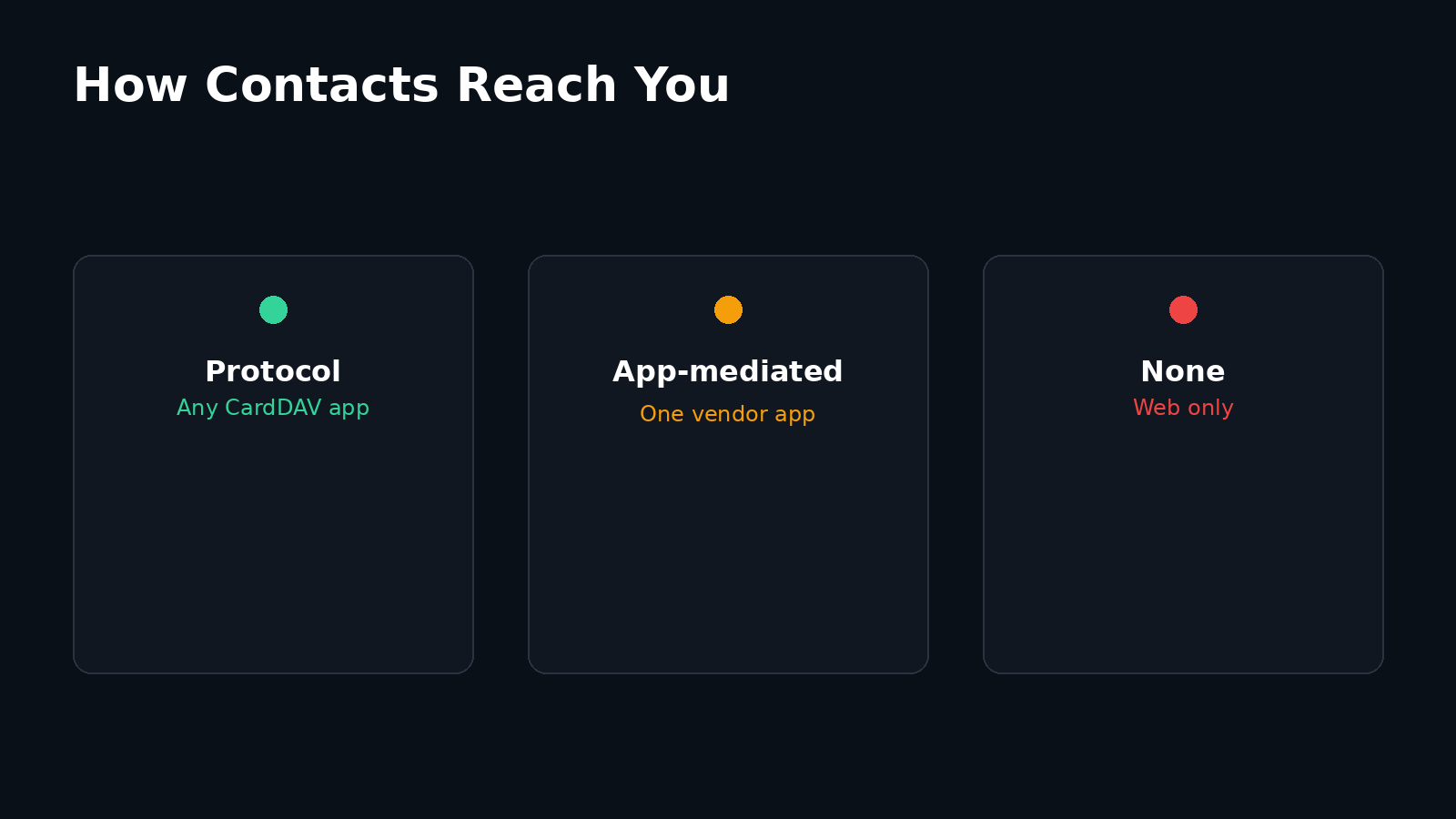
This axis is why the matrix above has a CardDAV column at all. Two services can both keep the server out and still differ completely in how replaceable they are.
How does SilentSuite handle contacts?
SilentSuite encrypts the entire vCard on your device before it reaches the server: names, numbers, addresses, photos, custom fields, and the relationships you record between people. The server stores ciphertext and sees item existence, item counts, and revision timestamps. What is covered and what is not is set out field by field in what SilentSuite actually encrypts.
On Android, SilentSuite registers a sync adapter and writes into the system contacts provider, the same mechanism Google and Exchange accounts use; the step-by-step version is in how to sync contacts on Android without Google. On desktop, the SilentSuite bridge decrypts locally and serves CardDAV on 127.0.0.1, so Apple Contacts on macOS and Thunderbird read the same address book. iOS is on the roadmap, coming soon, and is not currently supported.
EteSync gets to the same place by the same route, because it is the same protocol. The difference is maintenance rather than cryptography. The EteSync Android app shipped v2.7.0 on 2026-03-09 and hosted signup is open, but that one client is the exception. Across the EteSync GitHub organisation, the server repository has not been committed to since July 2024, the JavaScript client not since early 2023, the iOS client not since 2022, and the etesync-dav bridge's last functional release was v0.35.1 in August 2025. The maintainer's own status update from 2023-12-20 said development had slowed. EteSync is mostly abandoned, and that is the distinction worth keeping straight.
What does encrypted contact sync cost in 2026?
Prices as of 2026-08-15, taken from vendor pages that rendered a figure during my checks.
- Google Contacts and iCloud Contacts come bundled with accounts you probably already have. Neither keeps the server out, so the price is not really the question.
- Proton has a free tier; Mail Plus lists at €4.99/mo monthly or €47.88 a year, which is €3.99/mo on annual billing.
- Tuta has a free tier; the Revolutionary plan is about €3/mo from Tuta's own 2023 pricing announcement. I could not re-verify a live figure on tuta.com on 2026-08-15, so treat it as approximate.
- Nextcloud costs nothing as software. You pay for infrastructure, or for a managed provider.
- EteSync hosted is $2/month billed yearly for Personal and $4/month billed yearly for Supporter.
- SilentSuite is from €3/mo (annual) on the Early Adopter tier, or free if you self-host the AGPL-3.0 server.
Which encrypted contacts service should you choose?
If you want an address book the provider cannot read and you live inside one vendor's apps, Tuta is a good answer. The encryption covers the whole address book, the Android integration is real, and caller ID works. You are accepting that the set of places your contacts can appear is the set Tuta has built.
If you want an address book the provider cannot read and you want standard clients to read it, the field is EteSync and SilentSuite, both over Etebase with a local CardDAV bridge. SilentSuite is the actively maintained one; EteSync still ships an Android app and still takes signups.
If you self-host and the operator is you, Nextcloud is a defensible choice with the best protocol support in the matrix. Just do not confuse it with end-to-end encryption, because Nextcloud does not claim that for contacts and its documentation says the opposite.
If you are on Proton and assumed your contacts were fully covered, the thing to know is the field split, not that Proton did something wrong. Names and email addresses are readable to Proton. Everything else is not.
FAQ
Is Google Contacts end-to-end encrypted?
No. Google's own CardDAV endpoint returns names, numbers, and addresses as readable fields to authorised clients, which means the server holds them in readable form.
Is iCloud Contacts end-to-end encrypted?
No. Apple's security guide states that iCloud Calendar, Contacts, and Mail aren't end-to-end encrypted, and that holds with Advanced Data Protection enabled.
Which encrypted contacts services support CardDAV?
EteSync and SilentSuite, both through a local bridge that decrypts on your machine. Tuta and Proton do not support CardDAV. Google, iCloud, and Nextcloud support CardDAV but are not end-to-end encrypted for contacts.
Is Nextcloud Contacts end-to-end encrypted?
No. Nextcloud stores contacts as application data, and its own admin manual says server-side encryption covers file contents only and does not protect data from a compromised server or a malicious administrator. If you run the server yourself, the operator reading it is you.
Can I move my contacts out later?
From SilentSuite, yes: standard .vcf files out of the web client, and any CardDAV client can pull an independent copy through the bridge. Proton and Nextcloud export vCards too. Tuta documents import rather than export in the sources I checked.
How much is SilentSuite?
From €3/mo (annual) on the Early Adopter tier during the public beta, or free if you run the AGPL-3.0 server yourself.
This post is the matrix. If you want the same field in narrative form, with a section per service and more on why an address book is a social graph rather than a list of names, read encrypted contacts in 2026. And if you want contacts your provider cannot read, get started with SilentSuite. No tracking.
Interested in private sync?
SilentSuite is available now as a public beta. Sign up and start syncing your calendar, contacts, and tasks with end-to-end encryption.
Get started for free