 Tim Ross
Fork or rebrand is a fair question to ask about any project that appears on top of someone else's protocol, and for SilentSuite the answer is specific and checkable. Its public repository combines three documented derivatives of EteSync projects with new web, shared-core, deployment, and documentation layers, all speaking the same Etebase protocol.
That distinction matters. SilentSuite did not replace Etebase with a new sync protocol, and it did not merely rename the complete EteSync product. The server and Android app preserve upstream provenance in NOTICE files, while bridge source files identify their etesync-dav origin. Other components use the same protocol to provide a maintained product around it. SilentSuite is independent and is not affiliated with or endorsed by EteSync or Etebase.
The hosted SilentSuite public beta starts from €3/mo billed annually, or you can self-host it under AGPL-3.0. For migration steps rather than source provenance, read the EteSync alternative and migration guide.
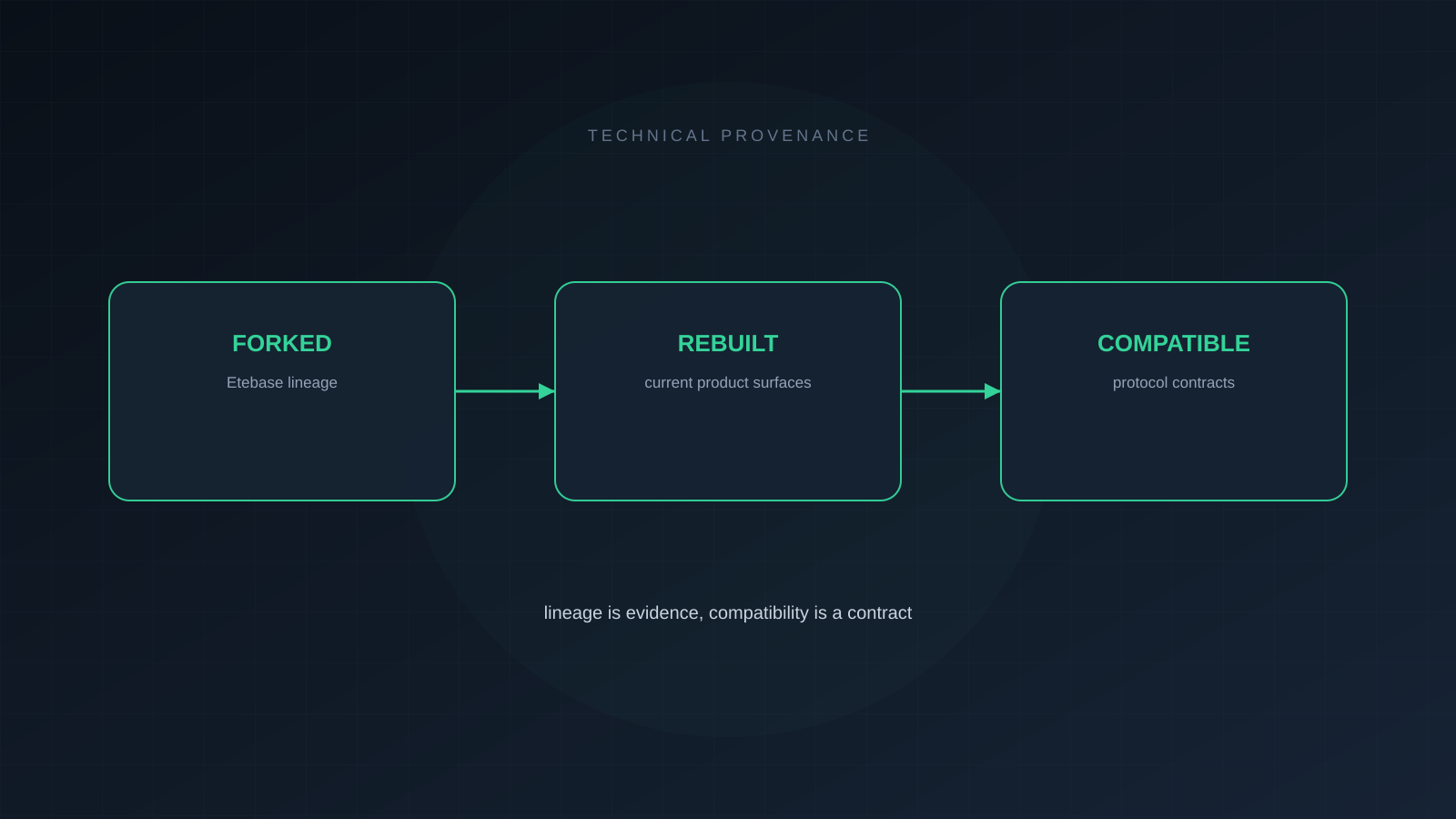
SilentSuite is a partial fork, not a rename. The sync server is forked from Etebase Server 0.14.2, the Android app is based on EteSync for Android, and the desktop bridge is adapted from etesync-dav. The web app, shared TypeScript core, and self-host bundle were built for SilentSuite around the same Etebase protocol. SilentSuite is independent and is not affiliated with or endorsed by EteSync or Etebase, and it preserves upstream attribution in NOTICE and license files.
Why did I fork EteSync instead of waiting for upstream?
I needed an actively maintained path for the complete product, not only a protocol specification. When the fork was assembled in March 2026, the Etebase server repository had not received a code update since July 2024, and the Etebase JavaScript repository's latest commits were from January 2023. That left core server and web-client dependencies without the release cadence needed for current deployment, security, and product work.
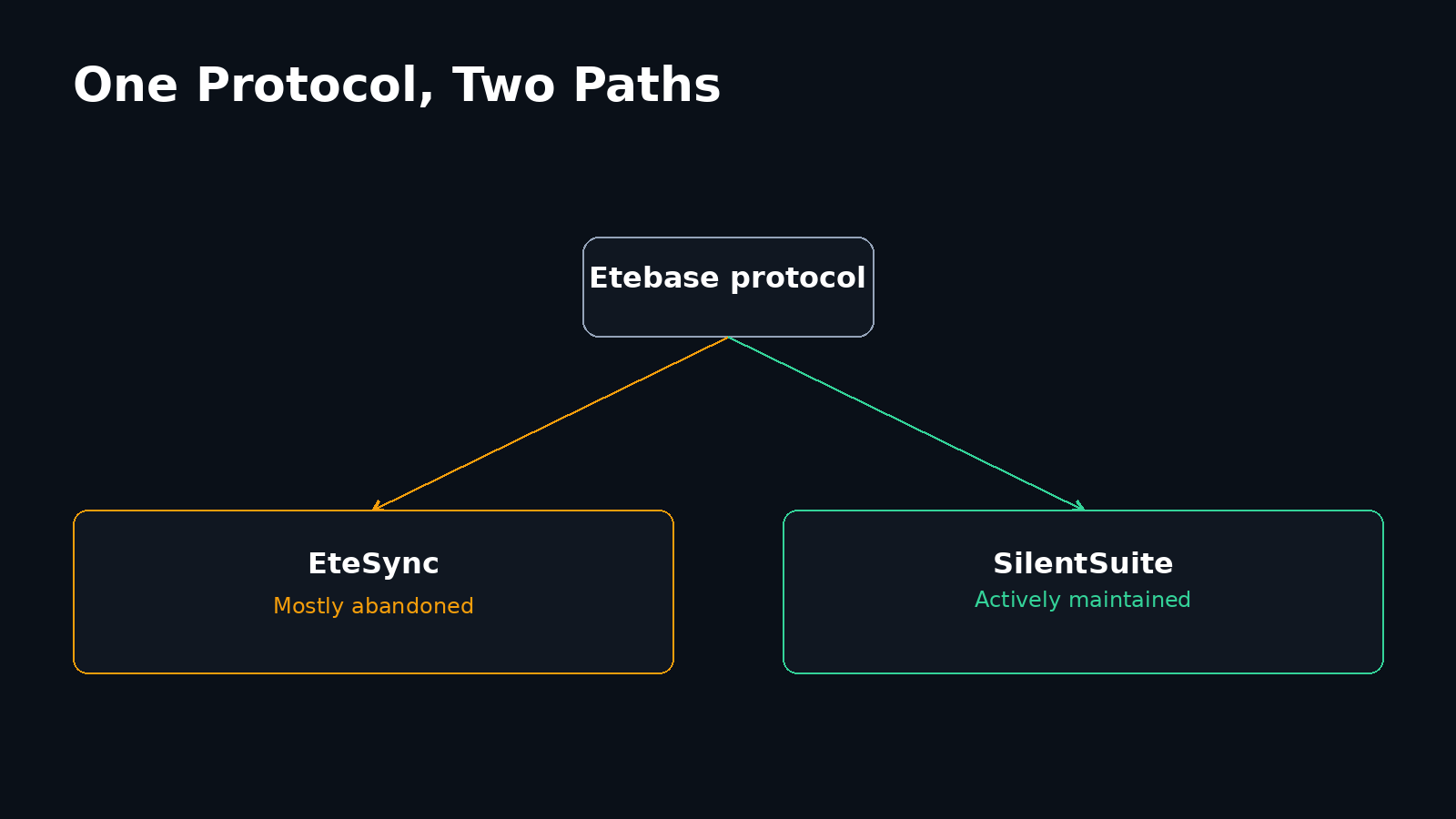
EteSync was, and is, mostly abandoned rather than entirely stopped. The Android app and etesync-dav received later maintenance, and the maintainer had already said in a status update published 2023-12-20 that “I have much less time than before so the development of the apps has slowed down.” The rest of the EteSync organisation went quiet. The problem was that no single upstream release train maintained the server, modern web product, Android integration, desktop bridge, self-hosting bundle, documentation, and operational checks as one supported system. Forking let me maintain those pieces together while preserving Etebase's proven client-side encryption and sync model.
I made the fork as a maintenance and product-continuity decision for users who need a current, supported product. Security and dependency fixes can ship without waiting for dormant core repositories, web and Android behavior can be tested against the same release, and self-hosters receive versioned deployment and recovery tooling. It was not an attempt to invent unreviewed replacement cryptography.
Which parts of SilentSuite were forked from EteSync?
Two component notices make direct ancestry clear. The server NOTICE says the SilentSuite server is based on Etebase Server by Tom Hacohen and EteSync contributors. Its changelog records the March 2026 fork point as Etebase Server 0.14.2. The Android NOTICE says the Android app is based on EteSync for Android. It also preserves attribution for DAVdroid/DAVx5, cert4android, ical4android, vcard4android, and the Etebase client library.
Bridge source files also state that they were forked and adapted from etesync-dav. SilentSuite has since changed the local account flow, cache, storage adapter, packaging, and installers, but the retained source attribution makes the derivative relationship explicit.
The licenses follow those lineages. The server, bridge, and repository are distributed under AGPL-3.0, while the Android subtree is distributed under GPL-3.0. Those are source and licensing facts, not a claim that every line in each derivative is unchanged from upstream.
Source map
Component provenance and preserved contracts
“Forked” applies precisely to documented derivative components. “Built for SilentSuite” means code that consumes the protocol rather than a fork of an EteSync user interface.
| Component | Provenance | SilentSuite layer | Preserved interface | Classification |
|---|---|---|---|---|
| Sync server | Forked from Etebase Server 0.14.2 | Maintained server changes, deployment, registration controls, tests, and security fixes | Etebase server protocol | Documented fork |
| Android sync app | Based on EteSync for Android and its DAVx5-derived libraries | SilentSuite package, release, setup, import, sync, UI, and security maintenance | Etebase plus Android calendar and contacts providers, with compatible task-app integration | Documented derivative |
| Web app | SilentSuite Next.js application | Calendar, contacts, tasks, import/export, local state, and sync UI | Uses the published Etebase JavaScript client | Built for SilentSuite |
| Shared TypeScript core | SilentSuite workspace package | Collection helpers, sync engine, data models, and iCalendar/vCard serialization | Uses Etebase collection and item APIs | Built for SilentSuite |
| CalDAV/CardDAV bridge | Forked and adapted from etesync-dav | Local account management, cache, DAV storage adapter, packaging, and installers | Etebase upstream; CalDAV/CardDAV on localhost | Documented derivative |
| Self-host bundle and docs | SilentSuite deployment layer | Compose stack, TLS proxy, configuration, verification, updates, and operations docs | Deploys the SilentSuite Etebase server and web client | Built for SilentSuite |
What did SilentSuite build for the new product, and what got better?
The current web client is a SilentSuite Next.js application, not a renamed copy of the historical EteSync web interface. It uses a shared TypeScript package for collection access, sync orchestration, and iCalendar and vCard data handling. That package depends on the published Etebase JavaScript client. This separates the application interface from the cryptographic sync library beneath it.
SilentSuite also maintains its adapted local bridge as a standalone component. The bridge uses Etebase upstream and exposes CalDAV and CardDAV to software on the same device through Radicale. Encryption and decryption happen locally, so the bridge is an adapter around encrypted sync rather than a plaintext DAV endpoint on the hosted server. The self-host bundle, web documentation, release packaging, and operational checks are SilentSuite layers around the protocol server.
In practical terms, the work is larger than a rename or a server fork:
- A new web application and shared TypeScript core provide current calendar, contacts, and tasks interfaces, shared data models, import and export flows, and one maintained sync implementation.
- A maintained product release train tests the web app, Android sync, bridge, server, and packaging together instead of asking users to assemble independently versioned projects.
- Safer self-hosting and operations add pinned Compose releases, verification scripts, signup controls, health checks, update tooling, and documented backup and restore procedures.
- A more complete local integration path packages the bridge and installers while keeping plaintext DAV on the user's device, not on the hosted server.
These are SilentSuite-specific application and deployment layers. Public history does not prove clean-room authorship for every imported line, so “built for SilentSuite” is the precise claim. It does not mean replacing Etebase's cryptographic client libraries or removing upstream attribution. SilentSuite improves maintainability, release safety, usability, and deployment while retaining the protocol boundary that made Etebase valuable in the first place.
The public monorepo starts with a consolidated SilentSuite release on March 19, 2026. Because that first commit imports several components at once, commit timestamps inside this repository do not prove that every imported line was first written on that date. The component notices and retained upstream changelogs are the stronger provenance evidence.
Which Etebase compatibility contracts does SilentSuite retain?
The retained contract is the Etebase model: client-side encryption, authenticated accounts, encrypted collections and items, revision history, and sync tokens. SilentSuite also keeps the established PIM collection identifiers etebase.vevent, etebase.vtodo, and etebase.vcard. The SilentSuite-specific preferences collection is separate from those three PIM types. For the field-level view of what that encryption boundary covers and which structural metadata the server still sees, read What SilentSuite actually encrypts.
Compatibility boundary
These statuses describe contracts visible in source and project documentation. They do not certify every third-party client.
| Surface | Status | What the evidence supports |
|---|---|---|
| Etebase wire protocol | Retained | The server identifies itself as an Etebase protocol implementation, and SilentSuite clients use Etebase client libraries. |
| Collection types | Retained for PIM data | Calendar, task, and contact collections use etebase.vevent, etebase.vtodo, and etebase.vcard identifiers. |
| Encryption boundary | Retained | Client code encrypts before sync. The server stores protocol objects and does not receive a usable or plaintext account encryption key. |
| Existing EteSync account | Not portable by protocol alone | A shared protocol does not copy an account, credentials, collections, or server-side membership to a different service. |
| Any EteSync or Etebase client | Not a blanket guarantee | Protocol lineage is evidence of a common interface, not proof that every historical client, release, and workflow is supported. |
| CalDAV/CardDAV clients | Via the local bridge | The bridge translates local DAV requests to encrypted Etebase sync. The hosted server does not expose plaintext DAV. |
The protocol documentation at docs.etebase.com explains the client and server model. SilentSuite's public repository shows where that model is used today. Together, those sources support a protocol-lineage claim. They do not support saying that arbitrary old applications can be pointed at any SilentSuite deployment without testing.
Can an existing EteSync app or account connect directly to SilentSuite?
Not as a general promise. Protocol compatibility and product compatibility are different claims. A client may speak Etebase while still depending on a particular server URL, account flow, collection convention, operating-system integration, or app version. An EteSync account also belongs to its original server. Sharing a protocol does not move credentials, encrypted collections, invitations, or billing state between services.
SilentSuite therefore documents the clients and paths it supports instead of treating common ancestry as universal interoperability. For current product differences and tested migration instructions, read Looking for an EteSync alternative? This article stays narrower: it records source lineage and the interface boundaries visible in the code.
The same caution applies to DAV. CalDAV and CardDAV compatibility comes from the local SilentSuite bridge. A desktop calendar connects to that localhost adapter, and the adapter communicates with the encrypted server through Etebase. That does not mean the hosted server exposes a conventional plaintext CalDAV or CardDAV service. The loopback endpoint, local cache, and client compatibility of that adapter are described in how the SilentSuite CalDAV bridge works.
FAQ
Is SilentSuite a fork of EteSync?
Some components are. The server is documented as a fork of Etebase Server 0.14.2, and the Android app is documented as based on EteSync for Android. The bridge includes source forked and adapted from etesync-dav. The web app, shared TypeScript core, and deployment layers are maintained as SilentSuite components around the Etebase protocol.
Did SilentSuite fork the Etebase cryptography library?
The web core declares the published etebase JavaScript package as a dependency, and the bridge declares the Etebase Python package. The source evidence supports use of those client libraries, not a claim that SilentSuite replaced their cryptographic design.
Does the fork keep EteSync data formats?
SilentSuite keeps the Etebase encrypted collection and item model and the established calendar, task, and contact collection type identifiers. That is a protocol and data-model statement, not a guarantee that every export, client cache, or account can be copied directly between products.
Is SilentSuite affiliated with EteSync or Etebase?
No. The server NOTICE states that SilentSuite is independent and is not affiliated with or endorsed by EteSync or Etebase. The project preserves upstream attribution and license terms.
Where can I verify SilentSuite's provenance?
Start with the public repository's server and Android NOTICE files, the server ChangeLog, component license files, package manifests, and Git history. Those sources distinguish explicit derivatives from SilentSuite application and deployment code.
Is EteSync still maintained?
Mostly abandoned. EteSync for Android shipped version 2.7.0 on 9 March 2026 and hosted EteSync signup is still open, but that one client is the exception. The Etebase server has not been committed to since July 2024, the JavaScript client since early 2023, and the iOS app has been dormant since 2022. That is why SilentSuite maintains its own release train across server, web, Android, and bridge.
Can I self-host the SilentSuite fork?
Yes. The forked server and bridge are distributed under AGPL-3.0 and the Android subtree under GPL-3.0, so you can run the same server software SilentSuite hosts. Self-hosting is free beyond the infrastructure you pay for, and the hosted public beta starts from €3/mo billed annually.
EteSync and Etebase supplied the protocol foundation and substantial upstream code in the documented server, Android, and bridge derivatives. SilentSuite keeps that attribution visible while maintaining the system as a combined web, Android, bridge, server, and self-hosted project.
Interested in private sync?
SilentSuite is available now as a public beta. Sign up and start syncing your calendar, contacts, and tasks with end-to-end encryption.
Get started for free