 Tim Ross
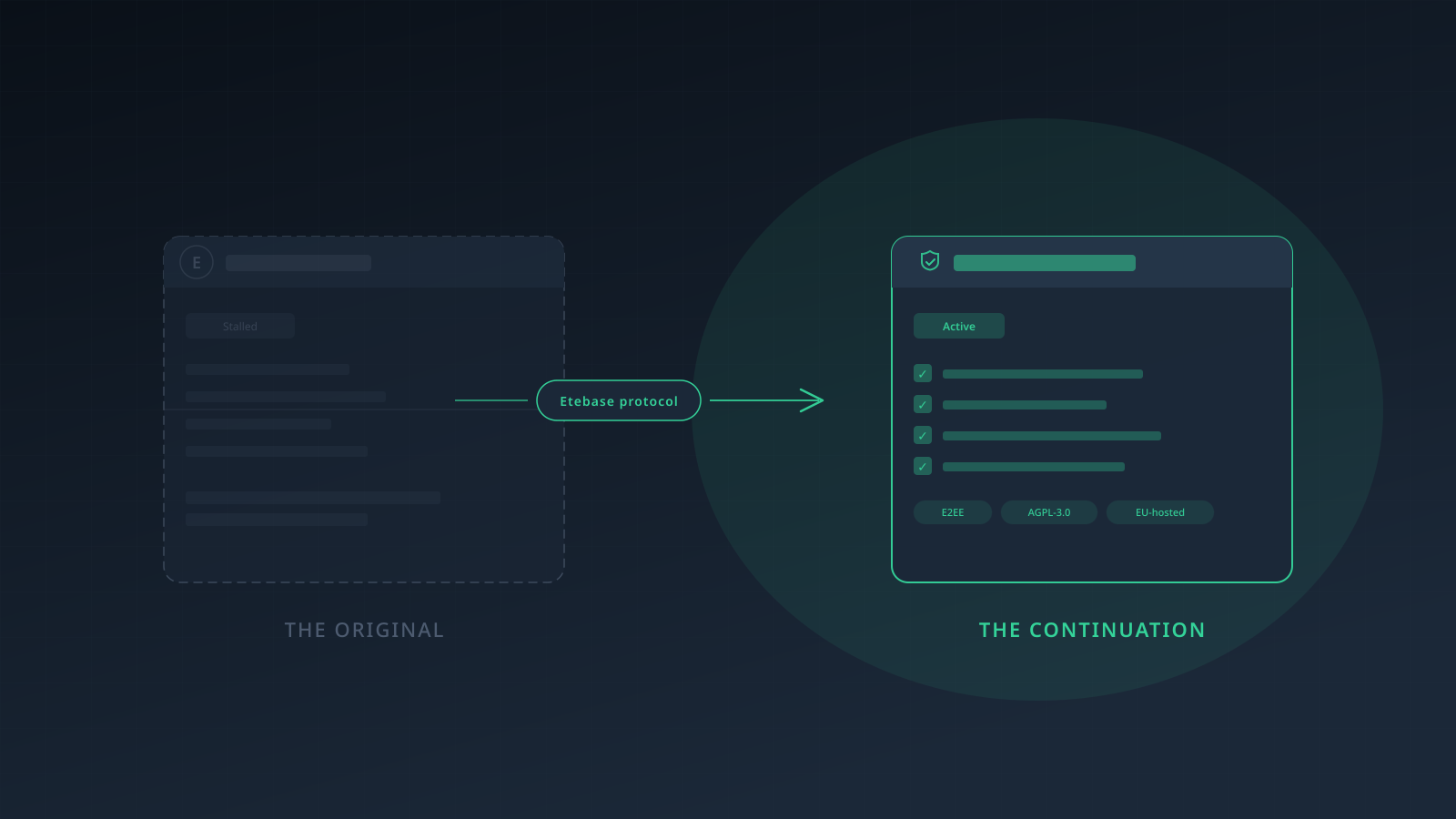
EteSync users tend to discover the problem the same way: an app stops updating, an issue goes unanswered, and the release page sits still for a year. SilentSuite is the maintained continuation, built on the same Etebase protocol underneath, so encrypted sync for calendars, contacts, and tasks works the same way and the zero-knowledge architecture is unchanged. What is new is the product around it.
That's the short answer. The longer answer is below: what happened to EteSync, what still works, what doesn't, what I changed, and the honest alternatives if SilentSuite isn't a fit for you.
EteSync itself is mostly abandoned: the server repository has not been committed to since July 2024 and the iOS client not since 2022, and only the Android app still ships occasional releases, most recently v2.7.0 on 2026-03-09. Because SilentSuite runs the same Etebase protocol, your data model carries over and migrating is an export and import through the web client, not a rebuild. SilentSuite is €3/mo hosted on the Early Adopter tier billed annually, or free to self-host under AGPL-3.0.
What happened to EteSync?
EteSync was the original end-to-end encrypted sync service for calendars, contacts, and tasks. It was built around the Etebase protocol, which is genuinely well-designed: zero-knowledge encryption, proper key management, conflict resolution, offline support. The cryptography is sound. For a long stretch, EteSync was the only service that did encrypted PIM (personal information management) sync properly outside of the walled gardens of Proton and Tuta.
The problem isn't the protocol. The protocol still works. The problem is that most of the product around it stopped moving. The EteSync GitHub organisation tells the story: the server has not been committed to since July 2024, the JavaScript SDK since early 2023, and the iOS client since 2022. Only the Android app and etesync-dav have seen later maintenance. For a service that handles your daily schedule, “it still kind of works on my phone” isn't enough. People started looking for somewhere else to go.
Is EteSync still maintained?
Mostly abandoned. The hosted service at etesync.com is still running. Existing accounts still sync. The Android app is still on F-Droid, and shipped v2.7.0 on 2026-03-09. If you have a working setup, it isn't going to vanish overnight.
But one shipping client is the exception, not the rule. The maintainer said as much in a status update published 2023-12-20: “I have much less time than before so the development of the apps has slowed down.” Two and a half years on, the core server and web components still have not had the release cadence a current maintained product needs.
How SilentSuite continues EteSync
SilentSuite is what happens when the protocol gets a maintained product around it. I forked Etebase, kept the same encryption and the same data model, and rebuilt the parts that had bit-rotted. New Android client, new web client, new CalDAV bridge, active server development, sustainable pricing.
Concretely, here's what stays the same and what's new:
- The Etebase protocol underneath
- Zero-knowledge encryption (server can't read your data)
- Calendars, contacts, and tasks in one product
- Open source server (AGPL-3.0)
- Self-hostable
- Native iOS app on the roadmap, coming soon
- Active development with a real release cadence
- Modern Android app, theme-aware light/dark
- Updated web client
- Standalone CalDAV bridge for Apple Calendar and Thunderbird
- Hosted from €3/mo, sustainable without ads or data sales
SilentSuite does not have everything EteSync had on day one. iOS is on the roadmap, coming soon, and is not currently supported. The project is early, but it is here and shipping.
How do I migrate from EteSync to SilentSuite?
SilentSuite shares EteSync's Etebase data model, but moving between the hosted services still requires an export and import. The shared formats help preserve events, contacts, and tasks through that process.

- Create a silentsuite.io account at app.silentsuite.io/signup. The free trial gives you time to migrate without committing.
- Export your EteSync collections from the EteSync web client or Android app. Each calendar, address book, and task list exports as a standard
.ics,.vcf, or task file. - Import into SilentSuite through the web client. The data model is identical, so events, contacts, and tasks come in intact, including recurrence rules and reminders.
- Re-point supported devices. On Android, install the SilentSuite app and sign in. For Apple Calendar on macOS or Thunderbird, install the standalone CalDAV bridge and connect it. iOS is not currently supported.
- Verify, then deactivate EteSync. Confirm a few recent events and contacts arrived correctly before pulling the plug on the old account.
SilentSuite has step-by-step migration docs on its help site, and if you hit a snag I'll help you through it. Migrating off a stalled service is exactly the kind of thing that should be friction-free.
Honest alternatives if SilentSuite isn't a fit
SilentSuite isn't the only encrypted-PIM option, and I don't pretend it is the answer for everyone. If you left EteSync for a mainstream provider instead, it is worth knowing who can read your calendar at each of them. If you're evaluating, the other realistic choices in 2026 are:
- Proton Calendar: End-to-end encrypted, bundled with Proton Mail, polished UI. No CalDAV, no third-party app integration, no proper task sync. Good choice if you live entirely inside the Proton ecosystem.
- Tuta Calendar: Similar trade-offs to Proton. Real encryption, locked into Tuta's own apps, no CalDAV. Tasks aren't a first-class feature.
- Nextcloud: Self-hosted, supports CalDAV and CardDAV, huge ecosystem. But calendar and contacts data is stored in plaintext in the Nextcloud database. Fine if you control the server, weaker if you use a hosted Nextcloud provider.
- Stay on EteSync: Genuinely an option if your current setup works and you accept the lack of updates. Your data isn't going anywhere as long as the hosted server keeps running. I just don't recommend it for new users in 2026.
For a deeper feature-by-feature breakdown of these services, see the full encrypted calendar comparison.
What isn't SilentSuite?
SilentSuite isn't a venture-funded privacy startup. It isn't chasing a billion-dollar exit. I'm building a sustainable product around a protocol I believe in, with the option to self-host the server if you don't want to trust the hosted service. If you are weighing those two routes, I set out the trade-offs in self-hosting vs hosted.
The same incentive structure that took down Skiff (acquired by Notion in 2024 and shut down) is something I explicitly designed SilentSuite away from. Open-source server, exportable data, AGPL-3.0 licensing, paid by users instead of investors. If SilentSuite ever goes away, you can take the server with you.
FAQ
Is EteSync abandoned?
Mostly abandoned. Only the Android app still ships occasional releases, most recently v2.7.0 on 2026-03-09, and hosted signup is still open. The server repository has not been committed to since July 2024, the JavaScript SDK since early 2023, and the iOS client has been dormant since 2022. The service still runs, but development across most of the stack has stopped.
What is the best EteSync alternative in 2026?
If you want to keep the Etebase protocol, SilentSuite is the actively maintained continuation and your existing data model carries over. Proton Calendar and Tuta Calendar are encrypted but have no CalDAV and no real task sync. Nextcloud speaks CalDAV and CardDAV but stores calendar and contacts data in plaintext.
Is SilentSuite the same protocol as EteSync?
Yes. SilentSuite uses Etebase under the hood, the same protocol EteSync built. That shared lineage does not make the EteSync iOS app compatible with SilentSuite today. iOS is on the roadmap and is not currently supported.
Is SilentSuite end-to-end encrypted?
Yes. Calendars, contacts, and tasks are encrypted on your device before they reach the SilentSuite server. The server holds ciphertext only. I can't read your events, contacts, or tasks even if I wanted to.
Can I self-host SilentSuite?
Yes. The server is open source under AGPL-3.0. You can run it on your own VPS or homelab and point SilentSuite clients at it.
How much does SilentSuite cost?
From €3/mo for the hosted plan. Self-hosting is free, you only pay for the infrastructure you run.
Does SilentSuite work with Apple Calendar on macOS or Thunderbird?
Yes, through the standalone CalDAV bridge. Install the bridge, sign in with your silentsuite.io account, and your encrypted data appears in Apple Calendar on macOS, Thunderbird, or another supported desktop client.
What happens to my data if SilentSuite shuts down?
You can export your collections at any time as standard .ics / .vcf files. The server is open source, so you (or anyone) can run it independently. Data lock-in is not part of SilentSuite's model.
EteSync proved encrypted PIM sync was possible. I'm making sure it stays available. If you've been waiting for someone to pick the project up, this is what I'm doing.
Get started with SilentSuite, or read the full comparison of encrypted calendar options if you want to see all your choices side by side.
Interested in private sync?
SilentSuite is available now as a public beta. Sign up and start syncing your calendar, contacts, and tasks with end-to-end encryption.
Get started for free