 Tim Ross
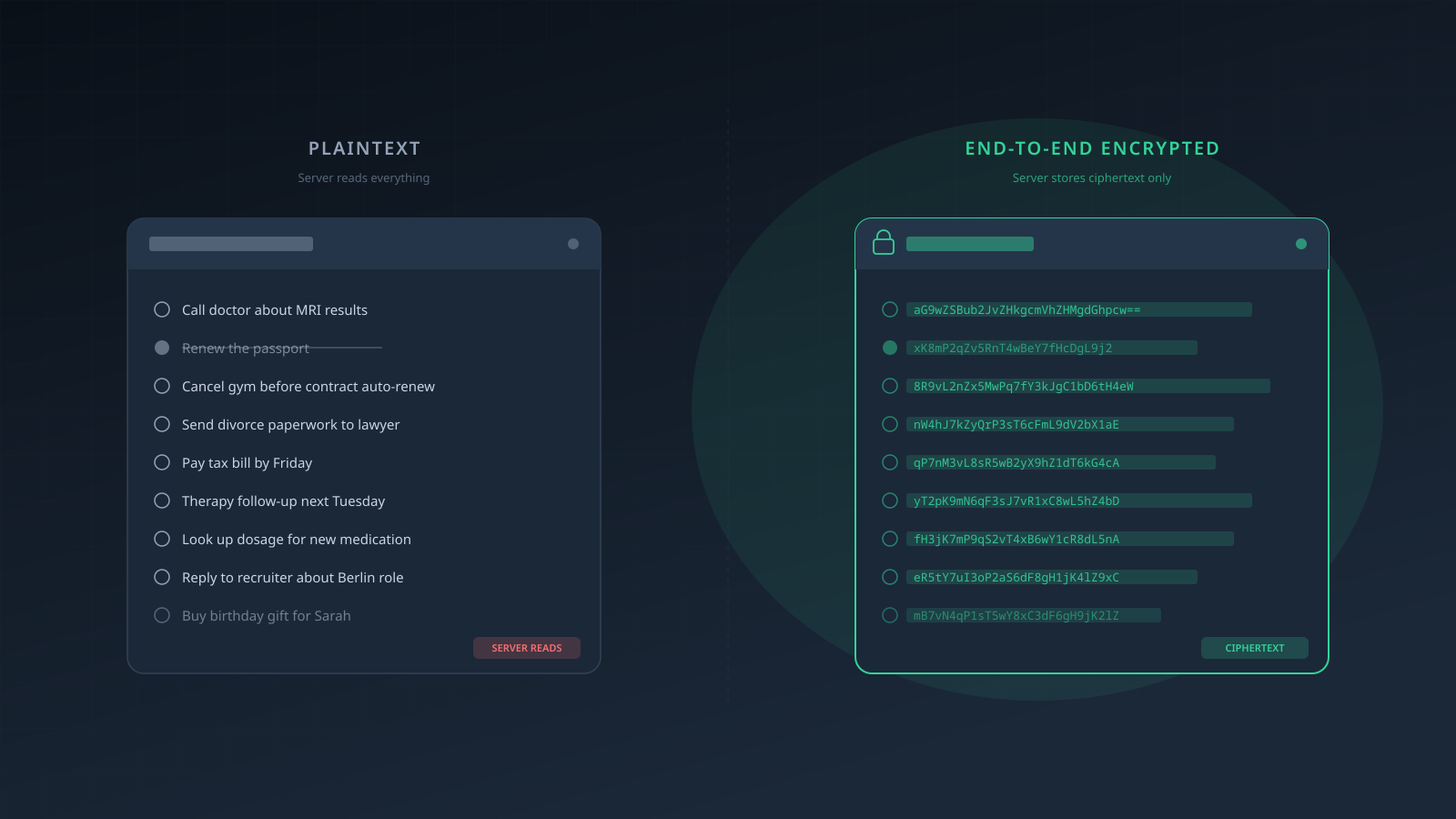
Your to-do list is where the private version of your life gets written down in the imperative: book the MRI, call the lawyer back, close the joint account. SilentSuite stores that list as ciphertext. Tasks are encrypted on your device with the same Etebase protocol as SilentSuite's calendar and contacts, so I can't read a single item. Hosted from €3/mo, AGPL-3.0 self-hostable.
That covers the question for SilentSuite. The harder question is the rest of the market. Almost every popular to-do list app, from Todoist to Apple Reminders to Google Tasks to Microsoft To Do, can read every item on your list. This post is an honest look at the landscape, and why I think encrypted task sync deserves more attention than it gets.
Todoist, Microsoft To Do, and Google Tasks are not end-to-end encrypted, so each provider can read every item on your list. Apple Reminders is end-to-end encrypted only if you turn on Advanced Data Protection, which is opt-in and off by default, and reminders synced over CalDAV are excluded from it. That leaves EteSync and SilentSuite as the only cross-platform options where the server holds ciphertext, both built on the Etebase protocol, and SilentSuite is the actively maintained one.
Why is your task list more sensitive than you think?
People are careful with their email and a little less careful with their calendar, where the answer to who can read your calendar is usually the provider. They're almost universally careless with their task list, because it feels like a notepad. It isn't.
Your tasks contain medication reminders. Therapy follow-ups. “Call the lawyer.” “Renew the visa.” “Cancel the gym before the contract auto-renews.” Personal health, legal exposure, financial deadlines. Tasks tend to be more concrete than calendar events, because calendar events are often shared and tasks are usually private notes-to-self. The result is a stream of plaintext intent that, in aggregate, describes the shape of your life with uncomfortable precision.
Now ask: who can read it? For most of the popular task apps, the answer is “the company that runs the service.” Sometimes the answer is “the company, plus its analytics partners, plus whoever issues a subpoena.”


Todoist
Todoist is the most-used cross-platform to-do app, and it's a genuinely good product. It is not end-to-end encrypted. Todoist's privacy and security page, last updated 2026-08-14, documents TLS in transit and encryption at rest, and makes no end-to-end encryption claim anywhere. Encryption at rest with the provider holding the keys means Todoist can read every item in your list and produce them in response to legal requests.
The absence of an E2EE claim is not the same as an admission, so I state it the way Todoist does: transit and at-rest encryption, no zero-access design.
Todoist also integrates with third parties (calendar sync, automation tools, AI features) which means your tasks are crossing additional trust boundaries. None of this is unusual or hidden. It's just worth being clear-eyed: if you wouldn't put it in a Google Doc, don't put it in Todoist either.

Microsoft To Do
Microsoft To Do is free, polished, and built on Outlook tasks underneath. Tasks live in your Microsoft 365 account and inherit the same trust model as your Outlook mailbox: encrypted at rest on Microsoft's servers, decryptable by Microsoft.
The proof is Microsoft's own API. The Microsoft Graph todoTask resource returns title, body, dueDateTime, reminderDateTime, recurrence, status, importance, categories, and checklistItems as ordinary readable fields, with no encryption described. Microsoft has not published a statement saying To Do is not end-to-end encrypted, so I point at the field list instead of inventing a quote.
For corporate use this is generally fine because the trust boundary is the company, not the individual. For personal use, it means a line item like “leave job” sits in plaintext on infrastructure your employer's IT department can sometimes reach.

Apple Reminders
Apple Reminders through iCloud is closer to the encrypted end of the spectrum, but not all the way there. With Advanced Data Protection for iCloud enabled, Reminders becomes end-to-end encrypted: it is one of the 23 data categories Advanced Data Protection covers. Without it, Apple holds the keys and can read your reminders.
Three honest limits. Advanced Data Protection is opt-in and off by default, and requires a recovery contact or recovery key. It is Apple-ecosystem-only in practice. And Apple's own security guide notes that reminders synced using CalDAV are excluded from end-to-end encryption, so the interoperable path is the unencrypted one. Within those limits, Reminders with Advanced Data Protection is a genuine encrypted task list and a real alternative to SilentSuite.

Google Tasks
Google Tasks sits inside Gmail and Google Calendar. It is not end-to-end encrypted. Google can read your tasks. Google does read your tasks, in the loose sense that the infrastructure processes them in plaintext for indexing, search, and increasingly for AI features. Anything in Google Tasks should be treated like anything in Gmail: convenient, integrated, and absolutely visible to Google.
Google Tasks is also the most locked-in task service of the group. Google's CalDAV API does not support VTODO, the standard calendar object type for tasks, so there is no standards-based way to read or write Google Tasks at all. The Tasks.org documentation describes the consequence: third-party clients must use the proprietary Google Tasks API, which lags the first-party app's features. No VTODO means no portability.

EteSync
EteSync was the first service to do encrypted tasks properly. The Etebase protocol underneath is genuinely well-designed: zero-knowledge encryption, conflict resolution, offline support, the works. Tasks are a first-class item type, and CalDAV VTODO works through the etesync-dav bridge.
Maintenance is minimal rather than absent, and the distinction matters. The Android app still ships: F-Droid lists v2.7.0, released 2026-03-09. Hosted signup is open at $2/month billed yearly. The server repository, on the other hand, has not been committed to since July 2024, and the bridge's last functional release was v0.35.1 in August 2025. Existing users still sync; new users should know which parts are moving and which are not.
I covered the shared protocol in detail in the post on why I picked the EteSync project up.

SilentSuite
SilentSuite handles tasks the same way it handles calendars and contacts. Items are encrypted on your device before they leave it. The SilentSuite server stores ciphertext only. I can't read your tasks even if I wanted to, because I don't have your key.
Tasks live in the same account as your calendar and contacts, so you don't need a separate subscription for each PIM category. And because SilentSuite shares the Etebase protocol with EteSync, anyone coming from EteSync brings their existing task lists with them. The calendar side of the same account is compared service by service in encrypted calendar sync in 2026.
How do encrypted to-do list apps compare in 2026?
Here's how the popular task apps stack up on encryption, openness, and lock-in. I've tried to be fair. If something is wrong, let me know.
| | | | | | |
|---|---|---|---|---|---|---|
| E2EE tasks | No | No | Partial | No | Yes | Yes |
| Server can read your tasks | Yes | Yes | Partial | Yes | No | No |
| Cross-platform | Yes | Yes | No | Yes | Yes | Yes |
| Open source | No | No | No | No | Yes | Yes |
| Self-hostable | No | No | No | No | Yes | Yes |
| CalDAV / standard sync | No | No | No | No | Via bridge | Via bridge |
| Status | Active | Active | Active | Active | Mostly abandoned | Active |
| Price | Free / paid plans | Free | Bundled with iCloud | Free | $2/mo (annual) | From €3/mo |
“Partial” for Apple Reminders means E2EE under Advanced Data Protection (opt-in, off by default; CalDAV-synced reminders excluded).
* SilentSuite tasks sync over the Etebase protocol natively. CalDAV for tasks (VTODO) is exposed through the standalone bridge for third-party clients like Thunderbird and Tasks.org. Google Tasks has no VTODO route at all, because Google's CalDAV API does not support VTODO.
Is there an end-to-end encrypted Todoist alternative?
Practically, the choices in 2026 are SilentSuite, EteSync on minimal maintenance, or Apple Reminders with Advanced Data Protection if you live entirely on Apple devices. Proton and Tuta both offer encrypted email and calendar but don't have a real task product. Standard Notes can do plaintext to-dos inside encrypted notes, which is closer to a notebook than a task list. Joplin can store to-do markdown notes encrypted, but it's a notes app first and not designed around the task workflow (recurrence, due dates, reminders, sub-tasks).
For dedicated, encrypted, cross-platform task sync that handles recurrence and reminders properly, the gap is real and SilentSuite is one of very few options trying to fill it.
What about offline-only apps?
Apps like Things (Apple-only) sync over iCloud and inherit Apple's trust model. Plain-text Markdown systems like Obsidian Tasks store everything locally, which is privacy-perfect but breaks the moment you want it on your phone too. Org-mode users have decades of clever sync solutions, all of which require sysadmin tolerance.
Local-first is a legitimate path. SilentSuite isn't local-only, but it is local-first in a meaningful sense: your client holds the keys, the server holds ciphertext, and your data is encrypted before it leaves the device. You get cross-device sync without giving the provider a window into your task list.
FAQ
Is Todoist end-to-end encrypted?
No. Todoist documents encryption in transit and at rest and makes no end-to-end encryption claim, so Todoist itself can read your tasks.
Is Apple Reminders end-to-end encrypted?
Only if you have Advanced Data Protection for iCloud enabled. By default, Apple holds the keys and can read reminders.
Is Google Tasks end-to-end encrypted?
No. Google holds the keys and processes tasks in plaintext, like the rest of Google Workspace.
Is Microsoft To Do end-to-end encrypted?
No. The Microsoft Graph todoTask resource returns task titles, bodies, due dates, reminder times, and recurrence rules as ordinary readable fields, with no encryption described.
Can I sync Google Tasks with CalDAV?
No. Google's CalDAV API does not support VTODO, the standard calendar object type for tasks, so the only route in is the proprietary Google Tasks API.
What's the best encrypted to-do list app?
For dedicated, cross-platform, end-to-end encrypted task sync with recurrence and reminders, compare SilentSuite (public beta, from €3/mo billed annually or self-hosted) with EteSync (same protocol, mostly abandoned). Apple Reminders with Advanced Data Protection is another option if you live entirely in the Apple ecosystem, though it is opt-in and off by default.
Can I self-host an encrypted task server?
Yes. SilentSuite's server is open source under AGPL-3.0 and runs on a standard Linux VPS or homelab.
Tasks deserve the same encryption as the rest of your data. They just usually don't get it. Sign up for SilentSuite if you want a to-do list your provider can't read.
Interested in private sync?
SilentSuite is available now as a public beta. Sign up and start syncing your calendar, contacts, and tasks with end-to-end encryption.
Get started for free