 Tim Ross
Spend any time in privacy communities and you'll hear one piece of advice repeated like a mantra: self-host everything. Run your own email server. Run your own cloud. Run your own calendar. And honestly, I get it. The instinct is right. If you control the hardware, you control the data. SilentSuite can be run exactly that way, self-hosted under AGPL-3.0, or used as a hosted service from €3/mo, and this post compares both routes against conventional self-hosted CalDAV.
But there's a gap between the ideal and what most people can actually sustain. Self-hosting a calendar is not like installing an app. It's more like adopting a pet that needs constant feeding. A pet that, if you forget about it for a few weeks, might leak your medical appointments to the internet.
I started SilentSuite for people who want private calendar sync without becoming full-time sysadmins. I also made self-hosting a requirement because I think you should have the choice. So let's talk honestly about both paths.
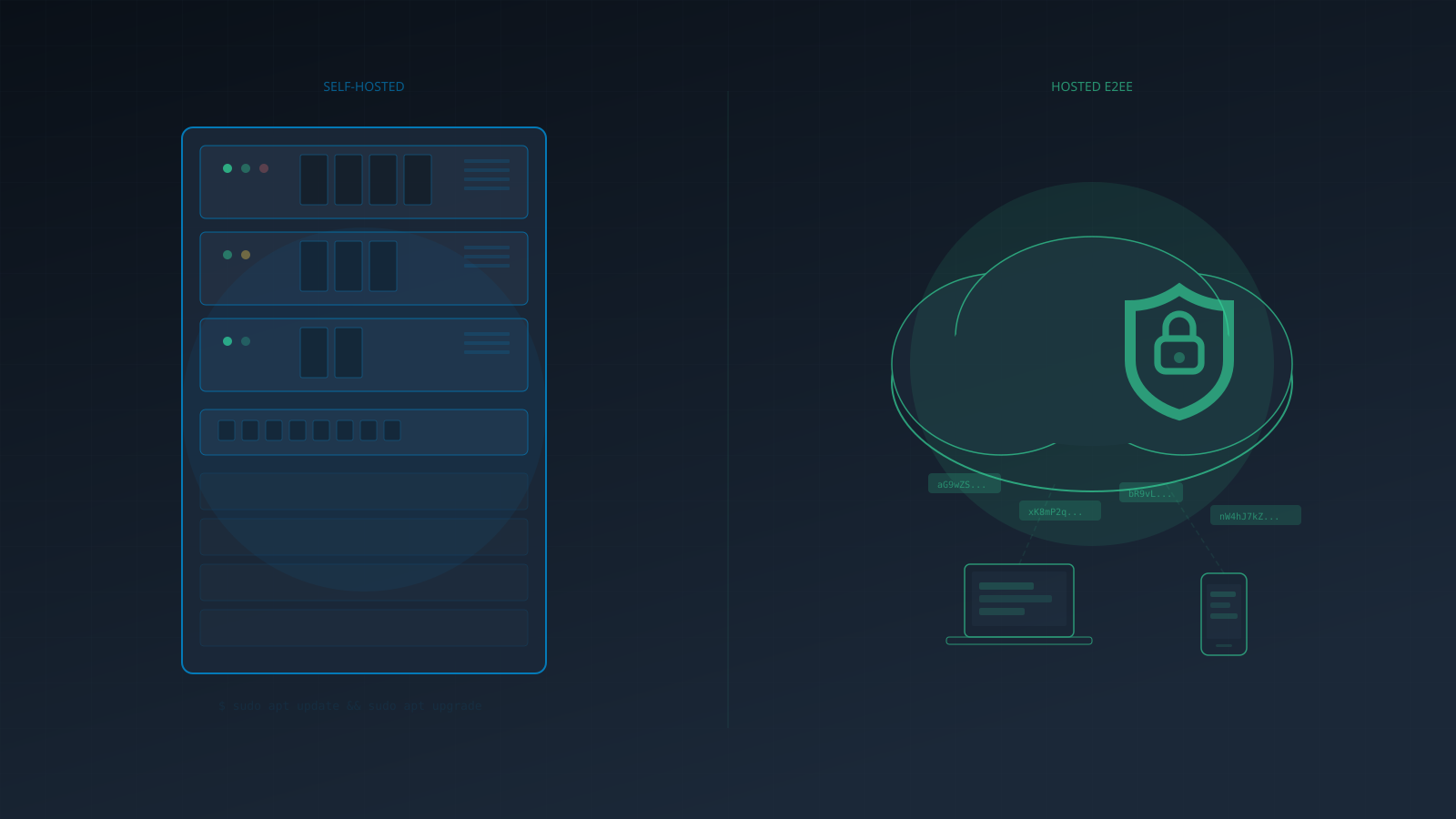
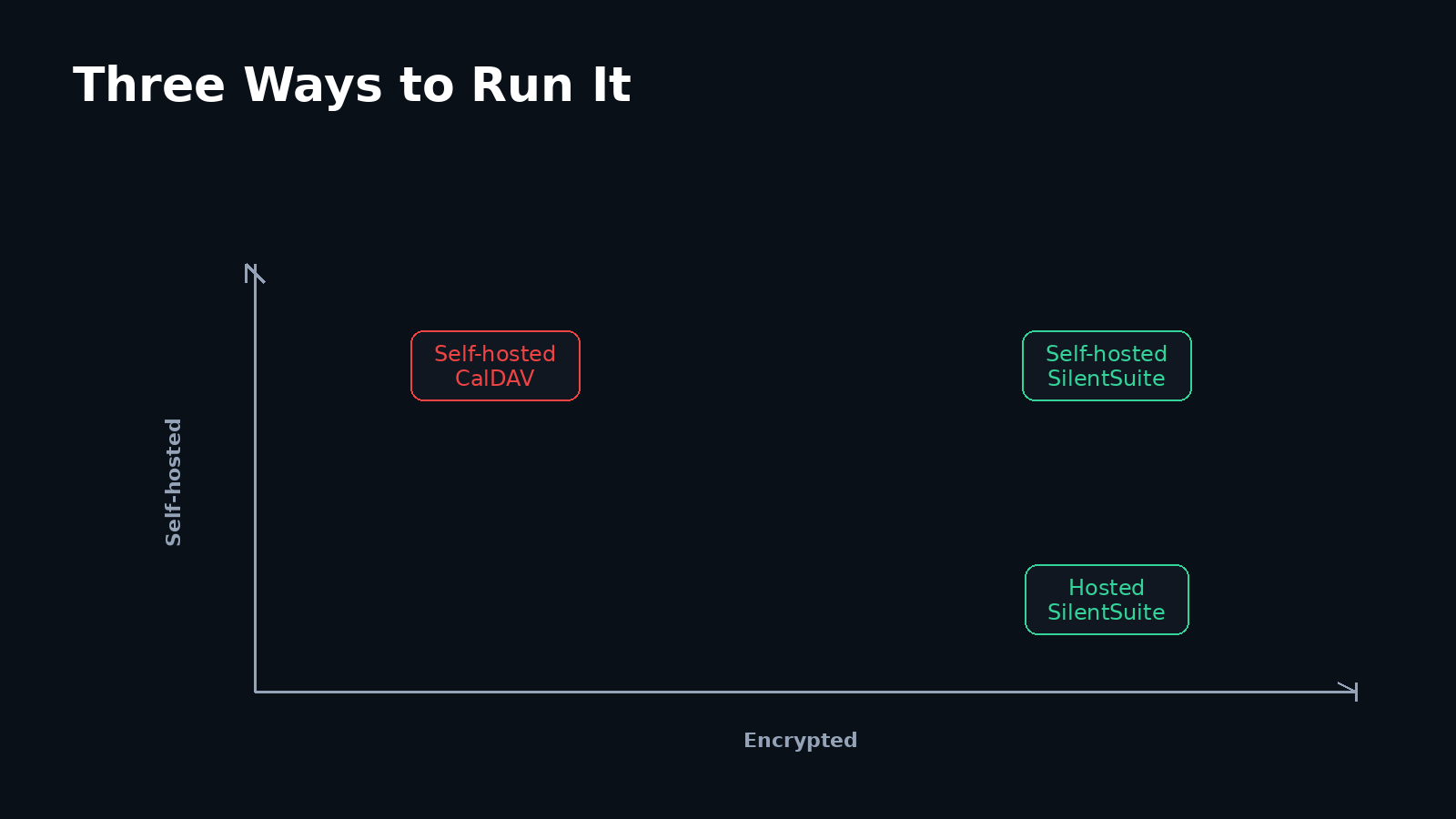
A conventional self-hosted calendar such as Nextcloud, Radicale, or Baikal still stores events in a form the server can read, so controlling the box is not the same as controlling who can read your schedule: anyone who reaches it reads everything. A hosted end-to-end encrypted service stores only ciphertext, so a breach or a legal request returns nothing usable, at the cost of trusting someone else to keep the service running. SilentSuite is available either way, hosted from €3/mo billed annually or self-hosted for free under AGPL-3.0, with exactly the same client-side encryption. If you do not enjoy running servers, hosted end-to-end encryption gives you the stronger data guarantee and none of the operational work.
What does self-hosting a calendar actually involve?
The most common self-hosted calendar setup is Nextcloud with its built-in CalDAV server. Other popular options include Radicale and Baikal. All of them work. All of them give you a CalDAV endpoint that syncs with standard calendar apps.
Here's what you actually need to run one:
- A VPS or home server (and if it's at home, a static IP or dynamic DNS)
- Docker or bare-metal Linux administration skills
- SSL certificates (Let's Encrypt, renewed automatically if you set it up right)
- A reverse proxy like Nginx or Caddy
- Regular backups to a separate location
- Security updates. Not just for your calendar software, but the OS, the web server, PHP, the database
- Monitoring, so you know when something breaks at 2 AM
This is a real commitment. Not a weekend project you set and forget. If you're already running a homelab and enjoy this kind of work, it slots right in. If you're not, you're signing up for ongoing maintenance that only you can do.
What does self-hosting give you?
Full control. That's the short answer. You pick the hardware. You pick the data centre (or your closet). You decide which software version runs, when it updates, and who has access. There is no third party involved. Nobody can change the terms of service on you, raise prices, or shut down the product.
For some people, this is enough reason on its own. I respect that. Self-hosting is a legitimate choice, and it's one I actively support by making SilentSuite's server code open source.
What does self-hosting not give you?
Here's the part that gets glossed over in most self-hosting advocacy: self-hosting does not automatically mean your data is encrypted.
Nextcloud stores your calendar data in a database. In plaintext. Radicale stores it as .ics files on disk. Also plaintext. If someone compromises your VPS, they can read every event on your calendar. If your hosting provider images your disk, same thing. If you forget to renew your SSL cert and fall back to HTTP for a day, your calendar data travels across the internet unencrypted.
Self-hosting means you are the security team. You handle intrusion detection, firewall rules, SSH hardening, software vulnerabilities. That's fine if you have the skills. But it's worth being clear-eyed about what you're taking on.
This is the same point I make about hosted providers, only turned around: the question is never who owns the hardware, it is who can read the events. Who can read your calendar works through that provider by provider, self-hosted Nextcloud included.
Owning the server doesn't mean the data is safe. It means you're the one responsible for making it safe.
How does a hosted end-to-end encrypted calendar compare?
There's another approach: use a hosted service, but one where the server literally cannot read your data. This is what end-to-end encryption (E2EE) gives you.
With E2EE, your calendar events are encrypted on your device before they leave it. The server stores ciphertext. The server operator, whether that's me operating SilentSuite or anyone else, cannot decrypt it. They don't have the key. A breach of the server reveals nothing useful. A subpoena returns encrypted blobs.
The trust model is fundamentally different from traditional hosting. You don't trust the server. You trust the math. The cryptography is what protects you, not a company's promise or a privacy policy.
A few services take this approach for calendars:
- SilentSuite (my project): E2EE calendar, contacts, and tasks sync using the Etebase protocol. Open source. Zero-knowledge encrypted.
- Proton Calendar: E2EE, bundled with Proton Mail. Closed ecosystem, but solid encryption.
- Tuta Calendar: E2EE, part of the Tuta email suite. Similar trade-offs to Proton.
The differences between them come down to what is encrypted, whether CalDAV is supported, licensing, and price. I put those side by side in encrypted calendar sync in 2026.
Is there a hybrid option?
Here's where it gets interesting. SilentSuite is fully self-hostable. The SilentSuite server is open source under AGPL-3.0, and you can run it on your own infrastructure.
That means you can have both: E2EE and full control of the server. Your data is encrypted before it reaches the server, and the server is yours. Even if someone breaks into your VPS, they get ciphertext. Not your calendar.
This combines E2EE with infrastructure control for people who want both. But the key point is: you don't have to. The hosted version gives you the same encryption guarantees without any of the server maintenance. The self-hosted option exists for people who want the extra control, not because the hosted version is less secure.
What does each option cost?
| Option | Server data | Operations | Typical cost |
|---|---|---|---|
| Self-hosted CalDAV | Readable event data | You manage the full stack | VPS plus your time |
| Hosted SilentSuite | Encrypted content | SilentSuite operates the service | From €3/mo billed annually during public beta |
| Self-hosted SilentSuite | Encrypted content | You manage the full stack | Software is free under AGPL-3.0 |
Let's talk money, because people often undercount the real cost of self-hosting.
- Self-hosted VPS: $5 to $10/month for a basic server (Hetzner, Contabo, DigitalOcean). Plus your time for setup, updates, backups, and troubleshooting. If you value your time at all, this adds up. A single evening debugging a broken Nextcloud update after a PHP version bump is worth more than a year of hosting fees.
- silentsuite.io hosted: From €3/month. I handle the server, the updates, the backups, the monitoring. You get E2EE sync that just works.
- Proton: Calendar is included with Proton paid plans, starting at €3.99/month on annual billing as of 2026-08-15. But you're buying the whole Proton ecosystem, which may or may not be what you need.
The hidden cost of self-hosting is time. Not just the initial setup, but the ongoing obligation. Security patches don't apply themselves. Backups need testing. Certs need renewing. Disks fill up. Things break on holidays.
Who should self-host?
Self-hosting makes sense if you:
- Genuinely enjoy running servers and treating infrastructure as a hobby
- Are a sysadmin by trade and this is just another service on your stack
- Have specific compliance requirements that mandate on-premises data storage
- Don't trust any third party with your data, even encrypted data
- Want to run SilentSuite's server yourself for the E2EE plus full-control combination
If any of those describe you, great. I actively support self-hosting and the SilentSuite server documentation is written with you in mind.
Who should use a hosted E2EE service?
Everyone else.
Specifically: people who use Signal instead of running their own XMPP server. People who use Proton Mail instead of configuring Postfix. People who chose Bitwarden's hosted service instead of self-hosting Vaultwarden. The approach is the same. Pick a service with strong encryption, open-source code you can audit, and a sustainable business model. Then get on with your life.
I sometimes call this the “privacy middle class.” Not apathetic about privacy, but not willing to make it a second job either. That's most people. And that's completely reasonable.
Privacy shouldn't require a Linux certification. It should be the default. E2EE hosted services make that possible by shifting the security burden from the user to the protocol. You don't need to trust the server because the server never sees your data in the clear.
The bottom line
Both paths are valid. Self-hosting gives you control. Hosted E2EE gives you convenience with equivalent (and in some ways stronger) security guarantees. The worst option is the one most people are stuck on right now: syncing plaintext calendar data through Google or Apple, where the provider can read everything and you control nothing. For what that default actually exposes, see SilentSuite vs Google Calendar.
I started SilentSuite for people who want privacy without a second job maintaining infrastructure. Calendar sync that's encrypted by design, hosted in the EU, open source, and simple to use. But I made the server self-hostable too, because I think the choice should always be yours.
FAQ
Does self-hosting make my calendar end-to-end encrypted?
No. Self-hosting changes who runs the server. Nextcloud, Radicale, and Baikal all store calendar data the server can read. End-to-end encryption is a client-side design choice, not a hosting choice.
Can I self-host SilentSuite?
Yes. The SilentSuite server is open source under AGPL-3.0 and runs on an ordinary Linux VPS or homelab. The software is free; you pay only for the infrastructure you run.
Is hosted SilentSuite less private than self-hosting it?
No. The encryption is identical. Your device encrypts before upload and the server holds ciphertext either way. Self-hosting changes who operates the box, not what the box can read.
How much does a private calendar cost?
A basic VPS is roughly $5 to $10 a month, plus your time. Hosted SilentSuite is “From €3/mo” billed annually during public beta. Self-hosting SilentSuite is free under AGPL-3.0 beyond the infrastructure you already pay for.
What do I have to maintain if I self-host?
TLS certificates, a reverse proxy, security updates for the OS and every service on the box, off-site backups you have actually tested, and monitoring so you find out before your calendar does.
Ready to try private calendar sync? Get started with SilentSuite.
Interested in private sync?
SilentSuite is available now as a public beta. Sign up and start syncing your calendar, contacts, and tasks with end-to-end encryption.
Get started for free